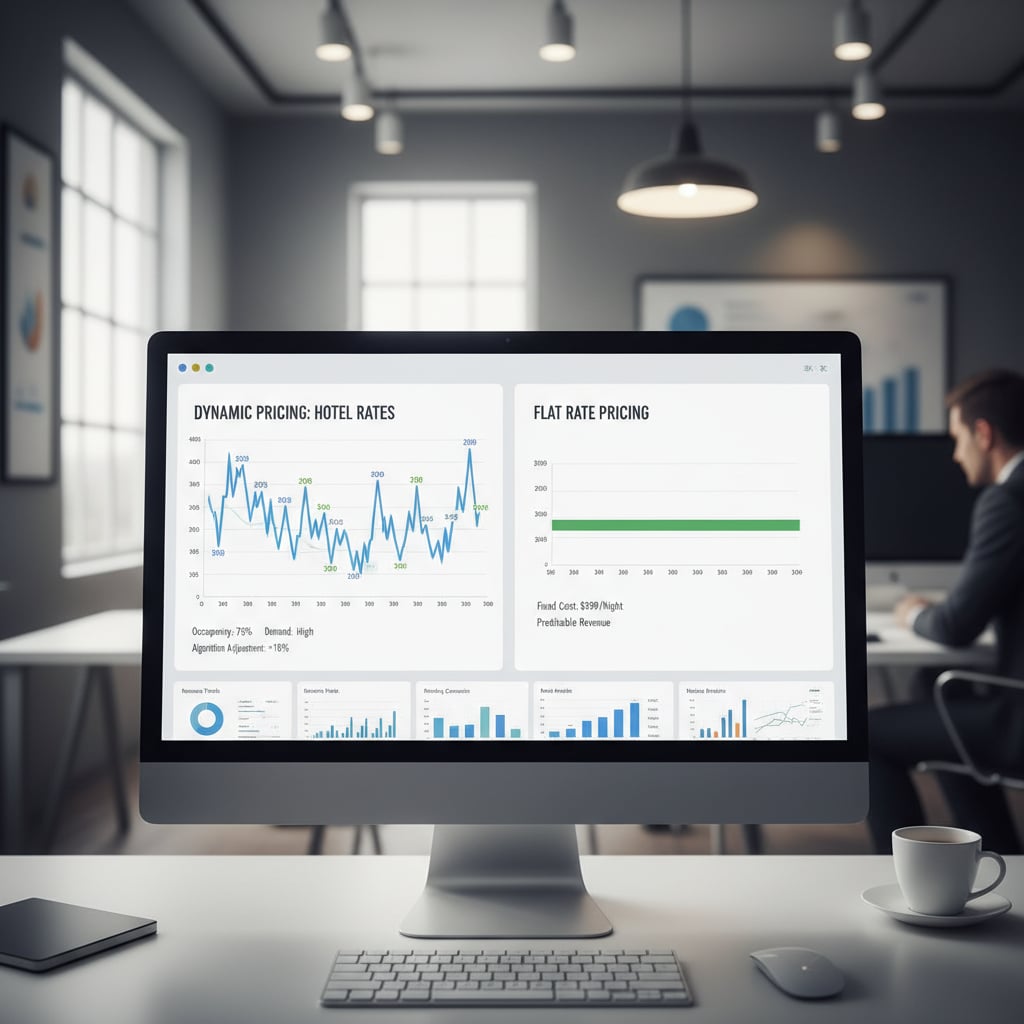
An agent called me frustrated: "I quoted a client $1850 for a 5-night hotel stay on Monday. She called back Thursday ready to book, and the same room was now $2100. I lost the booking." Welcome to the reality of dynamic pricing.
If you book hotels for clients, our B2B hotel booking portal lists contracted net rates with instant confirmation.
Understanding the difference between dynamic and static pricing isn't just academic—it directly impacts how you quote, when you book, and how you manage client expectations. Get it wrong, and you'll either lose bookings or leave money on the table.
Static Pricing: The Old-School Model
Static pricing is exactly what it sounds like: rates that stay the same regardless of demand fluctuations. The hotel sets a rate for a room category and season, and that rate holds whether they're at 30% occupancy or 95%.
You'll find static pricing in:
- Contracted agent rates: Many B2B contracts guarantee fixed rates for 6-12 months
- Allotment agreements: Hotels reserve inventory at agreed rates
- DMC rate sheets: Destination management companies often publish seasonal rate sheets
- Group booking contracts: Rates locked in months before arrival
When you're working with DMCQuote's contracted inventory, many rates are static—locked for the contract period. This gives you quoting certainty.
Advantages of Static Pricing for Agents
Quote with confidence: The rate you quote Monday is the rate you'll pay when you book Friday. No surprises, no awkward client conversations about price increases.
Easier margin management: You know your cost, you set your markup, you quote. Clean and simple.
Better for advance bookings: When clients book 3-4 months out, static rates protect you from seasonal price surges.
Clearer client communication: "Your total is $1650" doesn't need caveats about "subject to availability and rate changes."
Disadvantages of Static Pricing
You might miss rate drops: If demand weakens and hotels drop direct rates to 30% below normal, you're stuck paying your contracted static rate.
Less competitive during low season: Hotels using dynamic pricing might undercut your static rates when they're trying to fill rooms during slow periods.
Requires volume commitment: Hotels don't give static rates to everyone. You need proven booking history or allotment commitments.
Dynamic Pricing: The Revenue Management Approach
Dynamic pricing adjusts rates in real-time based on demand, competitor pricing, booking pace, and dozens of other variables. The rate for the same room can change hour to hour.
Hotels using sophisticated revenue management systems are constantly repricing inventory to maximize revenue. When they see strong demand, rates climb. When occupancy looks weak, rates drop to stimulate bookings.
You encounter dynamic pricing when you're using:
- Free-sale B2B platforms: Rates that update continuously based on hotel inventory systems
- API-connected booking systems: Live rates pulled from hotel reservation systems
- Direct hotel bookings: Published rates on hotel websites
- OTA platforms: Booking.com, Agoda, etc. all use dynamic pricing
Advantages of Dynamic Pricing for Agents
Capture low-season bargains: When hotels drop rates to drive occupancy, you can book at prices below your static contracted rates.
Access to flash sales and promos: Many promotions only apply to dynamically-priced inventory.
No volume commitments: You're not committing to allotments or minimum bookings—you book what you need when you need it.
Potentially better rates during soft demand: A hotel at 40% occupancy might offer rates 30-40% below your contracted static rate.
Disadvantages of Dynamic Pricing
Rate volatility: The rate you quote can change before your client confirms. This creates awkward situations and lost bookings.
Peak season price spikes: When demand is high, dynamic rates can jump 50-100% above off-season levels. Your "standard double room" goes from $120 to $240 overnight.
Harder to forecast margins: Your margin on a booking depends on when you happen to book. The same hotel might give you 25% margin in April and 8% margin in December.
Client trust issues: When clients see rates changing daily, they wonder if you're price-gouging or if they should just book direct.
How Hotels Decide Pricing Strategy
Understanding why hotels choose static or dynamic pricing helps you predict which properties will have which rate type.
Properties That Favor Static Pricing
- Business hotels with corporate contracts: Companies negotiate fixed rates for employee travel
- Group-focused properties: Hotels that primarily serve tour groups need predictable pricing
- Smaller independent properties: May lack sophisticated revenue management systems
- Markets with stable demand: Destinations without extreme seasonal swings
Properties That Favor Dynamic Pricing
- Chain hotels in competitive markets: They need pricing flexibility to compete
- Leisure-heavy destinations: Markets like Maldives or Dubai with dramatic high/low seasons
- Urban hotels in major cities: Pricing responds to events, conferences, holidays
- Properties with strong brand recognition: They can command premium pricing during high demand
When you're booking hotels in Singapore, you'll encounter both: Static rates from DMC partnerships and B2B contracts, dynamic rates when checking hotel direct or free-sale platforms.
Strategic Approach: Using Both Pricing Types
The smartest agents don't choose between static and dynamic pricing—they use both strategically depending on the situation.
When to Use Static Pricing Sources
Advance bookings (90+ days out): Lock in rates early before peak season pricing kicks in. If you're booking December hotels in August, static rates protect you.
Peak season and holidays: Christmas, New Year, Chinese New Year, summer holidays—these are when dynamic rates spike. Your static contracted rates become more valuable.
Group bookings: When you need 10+ rooms with consistent pricing across all rooms, static rates are essential.
Client payment schedules: If clients are paying deposits months before travel, you need rate certainty.
When to Use Dynamic Pricing Sources
Last-minute bookings (7-14 days out): Hotels trying to fill remaining inventory often drop dynamic rates significantly.
Off-season travel: When destinations like Thailand or Sri Lanka enter low season, dynamic rates can be 40% below contracted static rates.
Testing new properties: Before committing to static rate contracts, book a few rooms dynamically to test quality.
Competitive quoting situations: When you need the absolute lowest rate to win business, check dynamic sources.
Managing Client Expectations With Dynamic Rates
The biggest challenge with dynamic pricing isn't the rate changes—it's explaining them to clients without damaging trust.
Setting Expectations Upfront
When you quote dynamically-priced inventory, say this explicitly:
"The current rate for this hotel is $175 per night, but this is dynamic pricing that can change based on availability. I recommend booking within 48 hours to secure this rate. If you need more time to decide, I can check if we have static rate options that guarantee pricing."
This frames it properly: dynamic rates offer potential savings but require faster decisions. It's not you being pushy—it's how the pricing works.
The Hold vs Book Decision
Some B2B platforms let you hold rates for 24-48 hours. Use this when:
- Client is 90% ready to commit but needs to check one detail
- Rates are currently favorable and you expect them to rise
- You're comparing multiple properties and need time for client to decide
Don't use holds for clients who are "just thinking about it." Holds tie up inventory and you risk losing the rooms if the client doesn't book.
When Rates Change Before Booking
You quoted $1600 on Monday. Client calls Thursday ready to book, but the rate is now $1850. How you handle this matters.
Transparent approach: "The rate has increased since I initially quoted. This is dynamic pricing—the hotel adjusted rates based on demand. Here are your options: (1) Book at the new rate of $1850, (2) I can check alternative hotels with better pricing, or (3) I can look at our static rate inventory where prices are guaranteed."
Most clients understand if you explain it clearly. Where you lose trust is if they think you're arbitrarily changing prices.
Hybrid Models: The Best of Both
Smart B2B platforms and DMCs are moving toward hybrid pricing models that combine static and dynamic elements.
Flexible Allocation Pricing
The supplier maintains an allotment at static rates but also offers additional inventory at dynamic rates when available. You get:
- Guaranteed rooms at known pricing (the static allotment)
- Additional rooms at potentially better pricing when hotel occupancy is low
- Protection against rate spikes during peak demand
When you're using DMCQuote's hotel inventory, you're often accessing this hybrid model—contracted rates as baseline, with additional dynamic inventory when favorable.
Dynamic Rates With Price Ceilings
Some contracts establish dynamic pricing with maximum rate caps. The rate can fluctuate based on demand but can't exceed an agreed ceiling.
This protects you from extreme peak season spikes while still letting you capture low-season bargains. It's becoming more common in B2B contracts as both hotels and agents look for middle-ground solutions.
Technology Tools for Managing Mixed Pricing
If you're working with 5+ different sources (some static, some dynamic), you need tools to track what you've quoted and at what rate.
Simple Tracking System
Many agents use a quotation spreadsheet:
- Quote date
- Client name
- Hotel / Destination
- Rate type (Static / Dynamic)
- Rate quoted
- Valid until (for dynamic rates, usually 24-48 hours)
- Source (which supplier/platform)
When a client calls back to book, you check the quote date. If it's dynamic pricing and more than 48 hours old, you verify rates before confirming.
Platform Features to Look For
Better B2B booking systems flag rate types clearly:
- Static rates show "Rate guaranteed until [date]"
- Dynamic rates show "Subject to availability - verify before booking"
- Some platforms let you set alerts for rate drops on properties you quote frequently
Real-World Scenarios
Scenario 1: Beach resort in Phuket, booking 4 months in advance for Christmas week
Static rate approach: Book through DMC contract at $245/night. Locked rate, no surprises.
Dynamic rate check: Current dynamic rate is $210/night, but by December it'll be $320+.
Smart choice: Book static rate now. You're getting better pricing than you'll see at booking time, and you've got rate certainty for your client.
Scenario 2: Business hotel in Kuala Lumpur, booking 5 days in advance for low season
Static rate available: $110/night through your DMC
Dynamic rate check: Hotel direct shows $78/night (trying to fill rooms)
Smart choice: Book dynamic rate if your B2B platform can match it. The short booking window and low-season timing make rate changes unlikely.
Scenario 3: Maldives resort, booking 6 weeks out, shoulder season
Static rate available: $380/night (contracted DMC rate)
Dynamic rate check: Currently $350/night, but showing limited availability
Smart choice: Static rate. Maldives resorts can spike rates quickly when they sense demand. The $30 premium buys you certainty, worth it for a high-value booking.
Communicating Value to Clients
When clients question why they should book through you instead of direct (where they can watch prices themselves), emphasize your access to static inventory:
"While you can certainly book direct and monitor pricing, I have access to contracted rates that don't fluctuate with market demand. Many of my clients prefer knowing their exact cost upfront rather than gambling on dynamic pricing. Plus, if rates do drop, I'm monitoring multiple sources and can advise you on the best timing to book."
You're offering expertise and stability, not just transactions. That's worth something.
The Future: AI-Driven Pricing
Hotels are increasingly using AI revenue management systems that consider hundreds of variables: competitor pricing, weather forecasts, local events, booking pace compared to historical patterns, even social media sentiment.
This makes dynamic pricing more sophisticated but also more volatile. Rate swings of 40-60% within a week become normal during high-demand periods.
For agents, this increases the value of static rate sources. When pricing becomes too unpredictable for clients to tolerate, your access to contracted, stable rates becomes a competitive advantage.
Whether you're booking hotels in Malaysia, Hong Kong, or Europe, you'll encounter both static and dynamic pricing. Neither is better universally—the right choice depends on timing, destination, seasonality, and your client's decision-making speed.
Build relationships that give you static rate access for baseline inventory. Maintain dynamic rate sources for opportunistic bookings and last-minute deals. Monitor both, understand when to use each, and communicate the trade-offs clearly to your clients.
That's how you navigate modern hotel pricing without losing bookings to rate volatility or leaving margin on the table because you didn't check dynamic alternatives.