Understanding Meal Plan Basics
Hotel meal plans can make or break client satisfaction and significantly impact your profitability. Recommending the wrong meal plan leads to either overspending (full-board at a city hotel with great street food) or unexpected costs (room-only at a remote resort). This guide decodes all meal plan types and when to use each.
Hotel Meal Plan Codes at a Glance: RO, BB, HB, FB and AI
A meal plan in a hotel is the set of meals included in the room rate. Every rate sheet, contract and voucher uses one of the codes below; the same plan often has two names because Europe and the Americas label them differently.
| Code | Also called | What is included | Typical use |
|---|---|---|---|
| RO | EP (European Plan), Room Only | Room only, no meals | City hotels, short stays, self-catering |
| BB | CP (Continental Plan), Bed & Breakfast | Room plus breakfast (CP strictly means a continental breakfast) | Most leisure and business stays |
| HB | MAP (Modified American Plan), Half Board | Breakfast plus one main meal, usually dinner | Resorts, family holidays, tour series |
| FB | AP (American Plan), Full Board | Breakfast, lunch and dinner; drinks usually extra | Pilgrimage groups, remote resorts, escorted tours |
| AI | All Inclusive | All meals plus selected drinks and snacks throughout the day | Beach and island resorts |
| AI+ / UAI | All Inclusive Plus, Ultra All Inclusive | AI plus premium drinks, à la carte restaurants, minibar and extras, per resort | Premium resorts; check each property’s definition |
The rest of this guide explains what each plan means in practice, how the codes vary by region, and how to price and recommend them.
What Each Meal Plan in a Hotel Includes: BB, HB, FB and AI Explained
RO (Room Only) / EP (European Plan)
What's included: Accommodation only, no meals
When to recommend:
- City hotels with nearby dining options
- Destinations known for street food (Bangkok, Penang)
- Clients who want maximum dining flexibility
- Very short stays (1 night)
Typical cost saving vs breakfast-included: $10-25 per person per night
Commission impact: Lower base price = lower commission, but can upsell breakfast as add-on with higher markup
BB (Bed and Breakfast) / CP (Continental Plan)
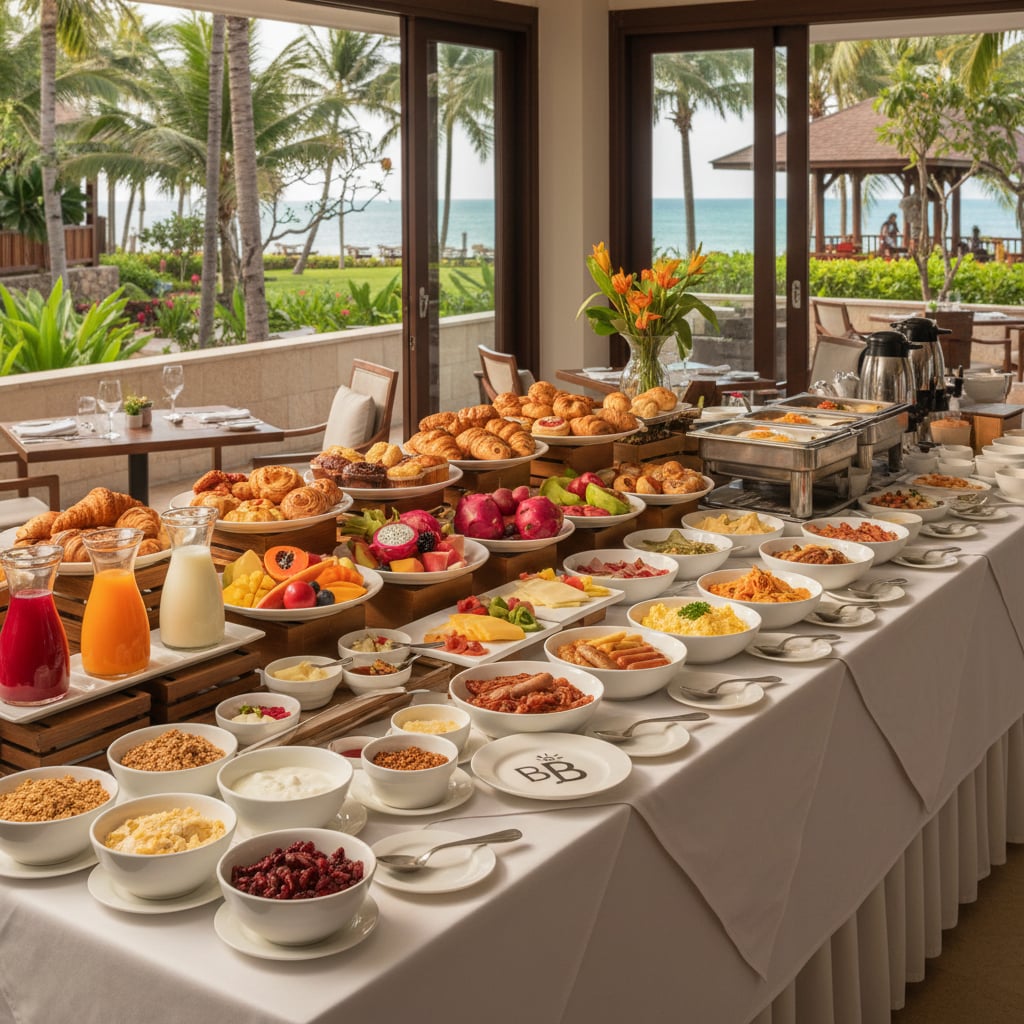
What's included: Accommodation + breakfast (buffet or à la carte)
Breakfast types:
- Continental: Pastries, cereal, juice, coffee (basic)
- American/Full: Continental + hot dishes (eggs, bacon, etc.)
- Buffet: Wide selection, international and local options
When to recommend:
- DEFAULT for most city hotels
- Business travelers (breakfast before meetings)
- Families with children (easier morning routine)
- Clients who want to explore local lunch/dinner options
Typical cost: +$15-35 per person per night vs room-only
Your markup opportunity: 15-25% on breakfast supplement
HB (Half-Board) / MAP (Modified American Plan)
What's included: Accommodation + breakfast + dinner (sometimes lunch instead of dinner)
Meal service:
- Breakfast: Usually buffet
- Dinner: Buffet or set menu (3-course typical)
- Drinks: Usually NOT included with meals (charged separately)
When to recommend:
- MOST POPULAR for beach resorts
- Remote locations with limited nearby dining
- Families wanting predictable costs
- Honeymoon packages (romantic resort dinners)
- Clients who prefer convenience over variety
Typical cost: +$35-65 per person per night vs BB
Your markup opportunity: 20-30% (clients can't easily verify resort restaurant pricing)
FB (Full-Board) / AP (American Plan)
What's included: Accommodation + breakfast + lunch + dinner
Meal service:
- All meals: Buffet or set menu
- Drinks: Usually NOT included (except water, sometimes)
- Snacks: Not included (unless specified)
When to recommend:
- Very remote resorts (island properties)
- Family-oriented resorts with kids
- Clients on strict budgets wanting no surprises
- Multi-day yacht/cruise packages
- Adventure tours (trekking, safari) where meals aren't easily available
Typical cost: +$50-90 per person per night vs BB
Your markup opportunity: 25-35%
AI (All-Inclusive)
What's included: Accommodation + all meals + drinks + selected activities
Typically includes:
- All meals (breakfast, lunch, dinner, snacks)
- Alcoholic beverages (local brands, sometimes imported)
- Non-alcoholic beverages
- Selected activities (non-motorized water sports, fitness, entertainment)
- Mini-bar (basic items)
Usually EXCLUDES:
- Premium imported drinks
- Motorized water sports (jet ski, scuba diving)
- Spa treatments
- Excursions outside the resort
- Fine dining specialty restaurants
When to recommend:
- Beach resort vacations (Maldives, Caribbean)
- Clients who want zero unexpected costs
- Families with teenagers (unlimited food/drinks appealing)
- Groups (bachelor parties, friend getaways)
- First-time travelers anxious about budgeting
Typical cost: +$80-200+ per person per night vs BB
Your markup opportunity: 30-40% (high perceived value, opaque pricing)
AI+ (All-Inclusive Plus) / UAI (Ultra All-Inclusive)
What's included: Everything in AI + premium additions
Additional inclusions:
- Premium imported spirits and wines
- Specialty restaurants (Japanese, Italian, etc.)
- 24-hour room service
- Motorized water sports
- Selected spa treatments
- Mini-bar with premium items
- Butler service (some properties)
When to recommend:
- Luxury resort stays
- High-budget honeymoons
- Clients who want absolute premium everything
- Special occasions (milestone anniversaries)
Typical cost: +$150-350+ per person per night vs BB
Your markup opportunity: 35-45%
BB vs HB vs FB by Region: How the Same Codes Differ
Asia-Pacific Region
| Destination | Common Meal Plan | Notes |
|---|---|---|
| Singapore | BB | Excellent hawker centers; clients want to explore food scene |
| Bali | HB or FB | Resort-focused; HB most popular for beach properties |
| Maldives | AI or AI+ | Remote islands, expensive à la carte; AI makes sense |
| Thailand (Bangkok) | BB | Amazing street food; breakfast only recommended |
| Thailand (Phuket resorts) | HB | Beach resorts benefit from half-board |
| Malaysia (KL) | BB | City hotel; clients explore dining |
| Malaysia (Langkawi) | HB or AI | Resort island; meal plans add value |
Pricing and Profitability Analysis
Example: 5-Star Bali Resort (Per Person Per Night)
| Meal Plan | Supplier Cost | Your Sell Price | Your Markup | Profit/Night |
|---|---|---|---|---|
| Room Only | $120 | $145 | 21% | $25 |
| BB | $145 | $175 | 21% | $30 |
| HB | $190 | $240 | 26% | $50 |
| FB | $230 | $300 | 30% | $70 |
| AI | $310 | $425 | 37% | $115 |
Analysis:
- Absolute profit increases with upgraded meal plans
- Percentage markup increases too (clients can't verify meal costs)
- 5-night stay example: HB earns $250 vs RO earning $125 (100% more profit)
BUT: Only recommend if it makes sense for the client. Over-selling meal plans damages trust.
When Meal Plan Upgrades Make Financial Sense for Clients
Scenario: Bali resort vacation (couple, 5 nights)
Option A: Room Only
- Room cost: $145 × 5 = $725
- Breakfast at hotel: $20 × 2 × 5 = $200
- Dinners at nearby restaurants: $40 × 2 × 5 = $400
Total: $1,325
Option B: Half-Board
- Room + HB: $240 × 5 = $1,200
Total: $1,200
Client saves $125 with HB while you earn $250 vs $125 (100% more profit)
This is a win-win scenario. HB genuinely saves clients money at resort properties.
Decision Framework: Which Meal Plan to Recommend
Ask These Questions
- Hotel location: City center or remote resort?
- Trip purpose: Business, leisure, honeymoon, family?
- Client preferences: Adventurous foodies or prefer convenience?
- Nearby dining: Are there good restaurants within walking distance?
- Budget flexibility: Tight budget or flexible spending?
- Travel experience: First-time or experienced travelers?
Recommendation Matrix
| Hotel Type | Client Type | Recommended Meal Plan | Rationale |
|---|---|---|---|
| City Business Hotel | Business traveler | BB | Breakfast before meetings, dinner with clients/colleagues |
| City Leisure Hotel | Foodie couple | BB or RO | Want to explore local dining scene |
| Beach Resort | Honeymooners | HB or AI | Convenience + romantic resort dinners |
| Beach Resort | Family with kids | FB or AI | Predictable costs, kids eat a lot |
| Remote Island Resort | Any | AI | No nearby alternatives, expensive à la carte |
| Boutique City Hotel | Luxury traveler | BB | Quality breakfast, flexibility for gourmet dinners |
| Budget Hotel | Backpackers | RO | Cost-conscious, happy with street food |
Common Client Questions and How to Answer
Q: "Is half-board worth it or should we just do breakfast?"
For resorts:
"At this resort, half-board makes sense. Dinner at the resort restaurant averages $45 per person, but the half-board supplement is only $30 per person. You'll save $15 per person per dinner, plus you won't need to worry about finding restaurants every evening. The resort has three restaurants you can choose from with your half-board credit."
For city hotels:
"For your Singapore stay, I recommend just breakfast. The hotel is in the heart of Chinatown with amazing hawker centers and restaurants within 5-minute walk. You'll want to explore the local food scene—that's part of the Singapore experience. Half-board would tie you to the hotel when there are better, more affordable options outside."
Q: "What's the difference between all-inclusive and ultra all-inclusive?"
"Standard all-inclusive includes all meals, local beverages, and basic activities. Ultra all-inclusive adds premium imported drinks (think top-shelf spirits vs house brands), specialty restaurants beyond the buffet, motorized water sports like jet skiing, and sometimes spa treatments. For most guests, standard AI is plenty. Ultra AI makes sense if you plan to drink premium liquor daily or if specialty dining is important to you. The upgrade is about $80-100 per person per night."
Q: "Can we upgrade our meal plan after we arrive?"
"Yes, hotels allow meal plan upgrades on arrival, BUT it's always more expensive—typically 20-30% more than booking it with your room. I recommend deciding now based on your travel style. If you're unsure, let's book half-board for peace of mind. It's harder to downgrade once booked, but upgrading costs more."
Upselling Meal Plans Ethically
When to Upsell
Ethical upsell scenarios:
- Remote resort properties: Genuinely saves client money and hassle
- All-inclusive resorts: Client specifically wants no additional costs
- Families with children: Meal plans prevent constant "I'm hungry" moments
- Special occasions: Honeymoons benefit from romantic dinners included
When NOT to Upsell
Don't push meal plans if:
- City location with excellent nearby dining
- Client explicitly wants to explore local food
- Hotel restaurant quality is poor (check reviews)
- Client is very budget-conscious and street food is available
- Short stay (1-2 nights) where flexibility matters more
Upselling Script Example
"I've quoted breakfast-only since you're in Singapore for 3 nights. However, I want to mention that your hotel offers an excellent half-board option for an additional $40 per person per night. Their rooftop restaurant has amazing views and serves Asian-fusion cuisine. That said, your hotel is right by Maxwell Food Centre—one of Singapore's best hawker centers where you can get incredible local dinners for $8-12 per person. My recommendation? Stick with breakfast-only and explore the local food scene. But if you prefer the convenience and hotel dining experience, half-board is available. What sounds better for your travel style?"
This approach:
- Presents the upgrade option (you earn more if they choose it)
- Gives honest alternative (builds trust)
- Lets client decide based on preferences
- Positions you as advisor, not salesperson
Meal Plan Markup Strategies
Standard Markup Guidelines
| Meal Plan | Conservative Markup | Aggressive Markup | When to Use Aggressive |
|---|---|---|---|
| BB | 15-20% | 25-30% | Luxury properties, included in package |
| HB | 20-25% | 30-35% | Resort properties, honeymoon packages |
| FB | 25-30% | 35-40% | Remote resorts, family packages |
| AI | 30-35% | 40-50% | Luxury AI resorts, group bookings |
Rule of thumb: The more inclusive the meal plan, the higher markup you can apply (harder for clients to verify value).
Package Bundling Strategy
When selling packages, meal plans are less price-sensitive:
Itemized pricing:
- Room: $145/night
- Breakfast: $25/person
- Dinner: $40/person
Client calculates: "That's expensive breakfast!"
Package pricing:
- 5-night honeymoon package: $1,850 per couple
- Includes: Deluxe room, daily breakfast and dinner, spa treatment, transfers
Client thinks: "Great value for everything included!"
Meal plans buried in packages allow better margins.
All-Inclusive Resorts: Special Considerations
Understanding AI Resort Economics
All-inclusive resorts operate differently:
- Lower base commissions: Often 8-12% vs 15-20% for room-only bookings
- But higher total value: $400/night AI vs $150/night room-only
- Result: 10% of $400 ($40) beats 18% of $150 ($27)
AI Resort Commission Structures
| Booking Channel | Commission % | Notes |
|---|---|---|
| Direct with resort | 10-12% | Standard AI commission |
| Through wholesaler (net rate) | 15-20% markup | Net rate + your markup |
| Luxury consortia (Virtuoso) | 10% + amenities | Value-add perks for clients |
When to Recommend AI vs À La Carte Resorts
Recommend AI when:
- Client wants budget certainty (no hidden costs)
- Remote island location (Maldives, Seychelles)
- Family with teenagers (unlimited food/drinks appealing)
- Group travel (bachelor/bachelorette parties)
- First-time international travelers (less anxiety)
Recommend à la carte + meal plan when:
- Sophisticated travelers who want choices
- Clients who don't drink alcohol (AI wastes money)
- Food enthusiasts who want to explore off-property dining
- Locations with great nearby restaurants
Documentation and Transparency
What to Include in Quotations
Always specify:
- Exact meal plan code: "Half-Board (HB) - Breakfast + Dinner"
- What's included: "Buffet breakfast 7-10am, set-menu dinner 7-10pm"
- What's NOT included: "Drinks with dinner charged separately"
- Restaurant options: "Dinner at your choice of 3 resort restaurants"
- Upgrade options: "Can upgrade to Full-Board for +$25/person/night"
Sample Quotation Language
For Half-Board:
"Your package includes Half-Board (HB) meal plan: daily buffet breakfast (7:00-10:30am) and dinner at the resort's main restaurant (7:00-10:00pm, set menu or buffet). Beverages with dinner are charged separately. You're free to explore nearby restaurants for lunch or dine at the resort (à la carte pricing)."
For All-Inclusive:
"Your All-Inclusive package includes: unlimited meals at 4 restaurants (buffet + 3 à la carte, reservations required), unlimited local and imported beverages (selection of spirits, wines, beers, soft drinks), 24-hour snacks, non-motorized water sports, and evening entertainment. Excluded: premium imported spirits, specialty wines, spa treatments, and motorized water sports. À la carte specialty restaurants limited to 2 visits per stay."
Technology and Meal Plan Management
Modern booking systems help manage meal plan complexity:
- Real-time pricing: Instant cost calculations for different meal plans
- Automated proposals: Generate quotes showing meal plan options side-by-side
- Client comparison tools: "Compare RO vs BB vs HB" tables
- Margin tracking: See profitability of each meal plan option
DMC Quote's platform displays meal plan options with transparent pricing and commission structures.
Common Mistakes to Avoid
- ❌ Assuming BB is always best: Resorts often benefit from HB/FB
- ❌ Over-selling AI in cities: Wastes client money when great restaurants nearby
- ❌ Not clarifying what's included: "Dinner included" but client expects drinks too
- ❌ Ignoring hotel restaurant quality: Check reviews before pushing meal plans
- ❌ Not mentioning restrictions: AI specialty restaurants require reservations/limits
- ❌ Forgetting children's meal policies: Some properties offer free kids' meals on certain plans
Action Plan
- Audit current bookings: Are you under-utilizing meal plan upsells?
- Create meal plan guide: Document which destinations/hotels suit which plans
- Price comparison templates: Build tools showing RO vs BB vs HB costs
- Train your team: Ensure everyone understands meal plan economics
- Review hotel partnerships: Negotiate better meal plan supplement rates
- Client communication scripts: Prepare responses to common meal plan questions
Conclusion
Meal plans are more than just accommodation add-ons—they're profit centers that significantly impact both client satisfaction and your bottom line. The key is matching the right meal plan to the right situation: breakfast-only for city exploration, half-board for resort relaxation, and all-inclusive for remote luxury or budget-conscious travelers.
Understanding meal plan economics allows you to provide genuine value to clients while maximizing profitability. When recommended appropriately, meal plans create win-win scenarios: clients save money and gain convenience, while you earn higher commissions on increased booking values.
Master meal plan strategies to elevate your offerings from basic room bookings to comprehensive travel experiences. Want access to hotels with transparent meal plan pricing and commission structures? Explore DMC Quote's hotel platform.