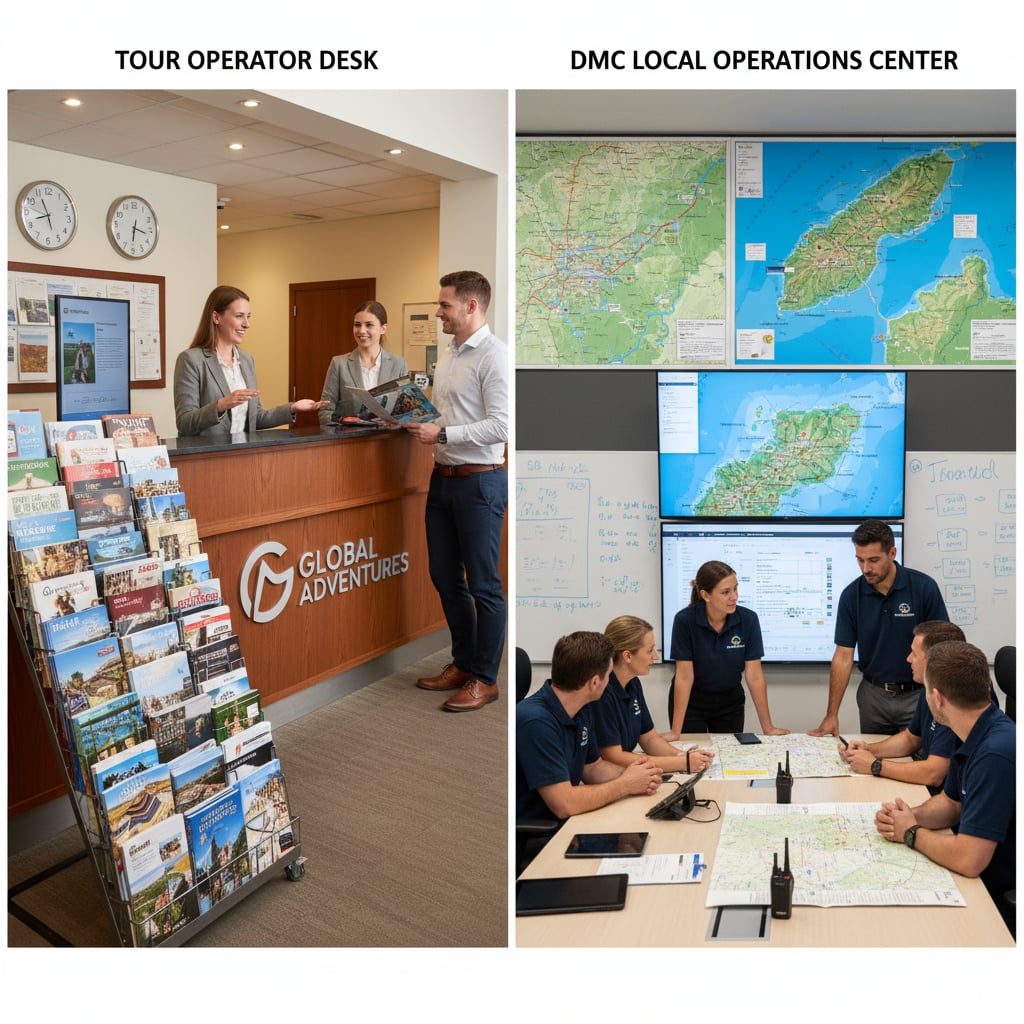
I've watched agencies thrive with the right DMC partner – and I've seen others struggle for months with unreliable suppliers before finally making a switch. The difference? Knowing exactly what to look for before signing that contract.
Choosing a DMC isn't like picking a hotel for a client. This is a business partnership that affects every booking, every client experience, and ultimately, your agency's reputation. Get it right, and you've got a competitive advantage. Get it wrong, and you're dealing with angry clients and lost commissions.
Why DMC Selection Actually Matters
Let me share a real scenario. An agency I worked with partnered with a budget DMC in Thailand purely based on rates – they were 15% cheaper than competitors. Sounds smart, right?
Three months later, they were dealing with:
- Clients left waiting 90 minutes for airport transfers
- Hotels claiming no reservation on file
- Tour guides who barely spoke English
- No one answering emergency phone lines after 6pm
They lost four major accounts before switching to a premium DMC. Those "savings" cost them approximately $40,000 in lost business. This is why selection criteria matter more than just price comparison.
Core Criteria for DMC Evaluation
1. Destination Coverage & Expertise
First question: Does this DMC actually specialize in the destinations you sell?
Some DMCs claim global coverage but are really just reselling through sub-agents in most markets. You want direct, on-the-ground presence. Here's how to verify:
- Ask for office addresses: Physical locations you can verify on Google Maps
- Request local phone numbers: Not just a generic +1 number forwarded somewhere
- Check staff locations: Are operations teams actually in-destination or remote?
- Review portfolio depth: How many contracted hotels? Tour options? Transfer operators?
For Asian destinations, I'd rather work with a DMC that does Singapore, Malaysia, and Thailand exceptionally well than one claiming to cover 50 countries mediocrely.
2. Technology & Booking Infrastructure
This is where many traditional DMCs fall behind. In 2025, you should expect:
| Feature | Why It Matters | Red Flag Alternative |
|---|---|---|
| Online Booking Platform | Instant quotes & reservations | Email-only communication |
| Real-Time Availability | Accurate inventory visibility | "Request on hold" for everything |
| Instant Confirmation | Immediate booking certainty | 24-48 hour confirmation waits |
| Mobile Access | Book from anywhere | Desktop-only systems |
| Automated Vouchers | Instant PDF generation | Manual voucher creation delays |
| Reporting Dashboard | Track bookings & commissions | Monthly Excel spreadsheets |
At DMC Quote, we built our platform specifically because we saw how inefficient traditional DMC workflows were. Modern agents need modern tools.
3. Financial Stability & Payment Terms
This is unsexy but critical. You need to know your DMC won't disappear with your deposits.
Questions to ask:
- How long have you been operating? (Under 3 years = higher risk)
- Are you bonded or insured?
- What are your payment terms? (Watch out for 100% upfront demands)
- Do you have credit facilities for established partners?
- What's your refund policy and processing timeline?
Reasonable payment terms usually look like:
- 20-30% deposit upon confirmation
- Balance due 30-45 days before travel
- Established partners may get NET30 terms
If a DMC demands 100% payment 90 days out? That suggests cash flow problems.
4. Supplier Relationships & Inventory
Here's what many agents miss: not all DMCs have direct relationships with suppliers. Some are just middlemen marking up another DMC's rates.
How to identify direct relationships:
- Ask to see sample hotel contracts
- Request their top 10 contracted properties in key cities
- Check if they have exclusive rates or allotments
- Verify their loading in supplier systems (if possible)
Direct relationships mean:
- Better rates (no middleman markup)
- More flexibility for modifications
- Stronger leverage when issues occur
- Priority service during high-demand periods
5. Customer Support & Emergency Handling
This is where the rubber meets the road. Flights delay, hotels overbook, clients get sick – how does your DMC respond?
Test these before committing:
- Response time: Send an inquiry at different times. How fast do they reply?
- Emergency contacts: Call their 24/7 line at 10pm or Sunday morning. Someone actually answer?
- Problem-solving approach: Present a hypothetical crisis. How do they respond?
- Communication quality: Are responses clear, professional, and complete?
Pro tip: The person answering your initial inquiries often isn't who handles ongoing bookings. Ask to speak with the operations team who'll actually service your clients.
Service Quality Indicators
Portfolio Depth & Diversity
Review what they actually offer across their service range:
Hotels: Do they have everything from budget to luxury? Can they accommodate different client needs, or do they push you toward specific properties?
Tours & Activities: Is the excursion portfolio comprehensive or just the standard tourist traps? Look for unique experiences and flexibility.
Transfers: Private, shared, luxury options? What's the vehicle fleet age and condition?
Additional Services: Can they handle visa assistance, special requirements, event planning, or are they purely basic services?
Customization Capability
Most clients don't want cookie-cutter packages. Your DMC should be able to customize.
Test this during the evaluation phase. Request something slightly non-standard – maybe a specific hotel that's not in their initial portfolio, or a private tour with modifications. How do they respond?
- Good DMC: "Let me check with the supplier and get back to you within 24 hours"
- Average DMC: "That's not in our standard offerings"
- Bad DMC: Just ignores the special request entirely
Pricing Structure Evaluation
Let's talk money. DMC pricing models vary, and understanding them helps you compare apples to apples.
Common Pricing Models
Net Rate + Your Markup: DMC gives you their rate, you add your margin. Clean and transparent.
Commissionable Rates: DMC quotes a "retail" price and pays you a percentage commission. Less transparent but simpler for some agencies.
Hybrid Model: Different approaches for different services (net for hotels, commission for tours).
Rate Competitiveness
Don't just compare on price alone, but do compare. Get quotes from 3-4 DMCs for identical services:
- Same hotel category/location
- Same tour inclusions
- Same transfer type
- Same dates (pricing varies by season)
If one DMC is dramatically cheaper (more than 30% below others), investigate why. Could be:
- Lower category hotels despite same "star rating"
- Shared transfers instead of private
- Less experienced guides
- Hidden fees not in initial quote
References & Reputation Check
Don't skip this step. Here's your due diligence checklist:
Ask for References
Request contact info for 3-5 agencies currently working with them. Specifically ask for:
- Agencies similar to your size/focus
- Partners who've worked with them for 2+ years
- Someone who handles your primary destinations
When you call those references, ask:
- What's been your best experience with this DMC?
- What's been the most challenging aspect?
- How do they handle problems when things go wrong?
- Would you recommend them? Any hesitations?
- What destinations do they excel in?
Online Research
- Google the company name + "reviews" or "complaints"
- Check LinkedIn for employee turnover (high turnover = red flag)
- Look for industry awards or memberships (ASTA, PATA, etc.)
- Review their social media presence and engagement
- Check business registration and tax compliance
The Test Booking Strategy
Before committing to major volume, do a test booking. Here's how:
- Choose a simple, low-risk booking: Maybe a 3-night hotel + airport transfers for 2 pax
- Go through the complete process: Inquiry, quote, booking, payment, voucher generation
- Evaluate each touchpoint: How smooth was it? Any confusion?
- Follow up with the client: How was the actual experience on the ground?
- Test modification: Try changing dates or making a small amendment. How's the process?
This investment in a test booking can save you from major headaches later. Think of it as cheap insurance.
Contract Negotiation Points
Once you've selected your DMC, don't just sign whatever they send. Negotiate these terms:
Payment Terms
- Can you get NET15 or NET30 instead of immediate payment?
- Is there flexibility for established booking history?
- What payment methods are accepted? (Wire transfer fees add up)
Cancellation Policies
- What are the cancellation penalties by service type?
- Any differences between FIT and group bookings?
- Force majeure clauses for uncontrollable events?
Service Level Agreements
Get specific commitments in writing:
- Quote response time (24 hours? 48 hours?)
- Booking confirmation timeframe
- Emergency response expectations
- Voucher delivery timeline
Commission Protection
- How are commissions calculated and paid?
- What's the payment schedule? Monthly? Per booking?
- Are commissions protected if the client cancels but you've done the work?
Red Flags to Absolutely Avoid
Walk away if you see these warning signs:
- No physical address or only PO boxes – Not a real DMC
- Unwilling to provide references – What are they hiding?
- Pressure tactics for immediate commitment – Professional DMCs don't need these
- Vague or evasive answers – Red flag for reliability
- No clear contract terms – Recipe for disputes later
- Demanding full payment far in advance – Cash flow problems
- Can't demonstrate direct supplier relationships – Just a middleman
- Poor English communication (for international DMCs) – Will cause ongoing issues
- No 24/7 emergency support – Unacceptable in this industry
Multi-DMC vs. Single Partner Strategy
Should you work with one DMC or multiple partners?
Single Partner Benefits
- Streamlined communication
- Better volume-based rates
- Consistent service standards
- Stronger relationship leverage
- Simplified accounting and reconciliation
Multi-DMC Benefits
- Best-in-class service per destination
- Competitive pricing through comparison
- Risk diversification
- Backup options if one partner fails
- Specialized expertise
My recommendation? Start with one solid regional DMC for your core destinations. As your volume grows, consider adding destination specialists for secondary markets.
Building the Partnership
Selecting a DMC is just the beginning. Here's how to build a strong partnership:
Year One: Establishing Trust
- Start with smaller bookings to test the relationship
- Provide detailed briefs to avoid miscommunication
- Give feedback – both positive and constructive
- Pay invoices on time (builds goodwill for when you need flexibility)
Regular Communication
- Schedule quarterly check-ins to discuss what's working
- Share your business goals so they can support growth
- Ask about new products, destinations, or rates
- Introduce them to your team so relationship isn't dependent on one person
Long-Term Partnership Benefits
Stick with a good DMC, and you'll unlock:
- Better net rates as your volume grows
- Priority access during peak season
- More flexible payment terms
- Custom packages developed specifically for your market
- First access to new properties or services
Questions to Ask During DMC Selection
Here's your ready-to-use question list for DMC calls:
About Their Business:
- How long have you been operating as a DMC?
- What are your primary destinations?
- How many agency partners do you currently work with?
- What's your average booking volume per month?
- Are you bonded/insured? Can I see proof?
About Operations:
- Where are your offices physically located?
- How many staff members in operations vs. sales?
- What are your hours of operation?
- How is 24/7 emergency support handled?
- What's your average quote response time?
About Services:
- How many contracted hotels in [specific city]?
- Do you have direct supplier relationships or work through sub-agents?
- Can you provide exclusive rates or allotments?
- What's your range of tour offerings?
- Do you handle FIT, groups, or both?
About Technology:
- Do you have an online booking platform?
- Can I see a demo before committing?
- Is there real-time availability or do I request quotes?
- How are vouchers generated and delivered?
- What reporting tools do you provide?
About Financials:
- What are your standard payment terms?
- What payment methods do you accept?
- What's your cancellation policy by service type?
- How are commissions calculated and paid?
- Do you offer credit facilities for established partners?
Regional Considerations
DMC expectations vary by region. Here's what to expect in key Asian markets:
Singapore: High professionalism, excellent English, premium pricing. Expect modern technology and reliable service. No excuses for delays or miscommunication.
Thailand: Wide range from excellent to questionable. Thoroughly vet before committing. Language can be a barrier with budget operators. Premium DMCs in Bangkok and Phuket are world-class.
Malaysia: Good middle ground between quality and value. Professional service standards improving rapidly. Strong for both leisure and MICE.
Maldives: Highly specialized. Most Maldives DMCs focus on luxury resorts and transfer logistics. Less variety in budget options.
Dubai: Ultra-professional, multilingual teams. High service expectations. Premium pricing reflects the destination positioning.
Making the Final Decision
After all this evaluation, how do you actually decide?
Create a scoring matrix:
| Criteria | Weight (1-5) | DMC A Score | DMC B Score | DMC C Score |
|---|---|---|---|---|
| Destination Coverage | 5 | |||
| Technology Platform | 4 | |||
| Pricing Competitiveness | 4 | |||
| Customer Support | 5 | |||
| Financial Stability | 4 | |||
| Supplier Relationships | 3 | |||
| Reference Feedback | 4 |
Score each DMC on a 1-10 scale for each criteria. Multiply by weight. Highest total score wins.
But also trust your gut. If something feels off during the evaluation process, it probably is. This is a partnership – you need to feel confident and comfortable with the team you'll be working with.
Final Thoughts
Choosing the right DMC partner is one of the most important decisions you'll make for your agency. Take the time to evaluate thoroughly. Ask hard questions. Don't be swayed by the cheapest price or the slickest sales pitch.
Look for a partner who demonstrates:
- Solid local presence and expertise
- Modern technology that makes your job easier
- Transparent communication and pricing
- Reliable service delivery and problem-solving
- Financial stability and fair payment terms
The right DMC becomes an extension of your team, enabling you to confidently sell destinations you've never personally visited and deliver experiences that keep clients coming back.
Ready to experience what a modern DMC partnership should look like? Register with DMC Quote and see our platform in action. Or explore our comprehensive services across Singapore, Malaysia, Thailand, Dubai, and the Maldives.