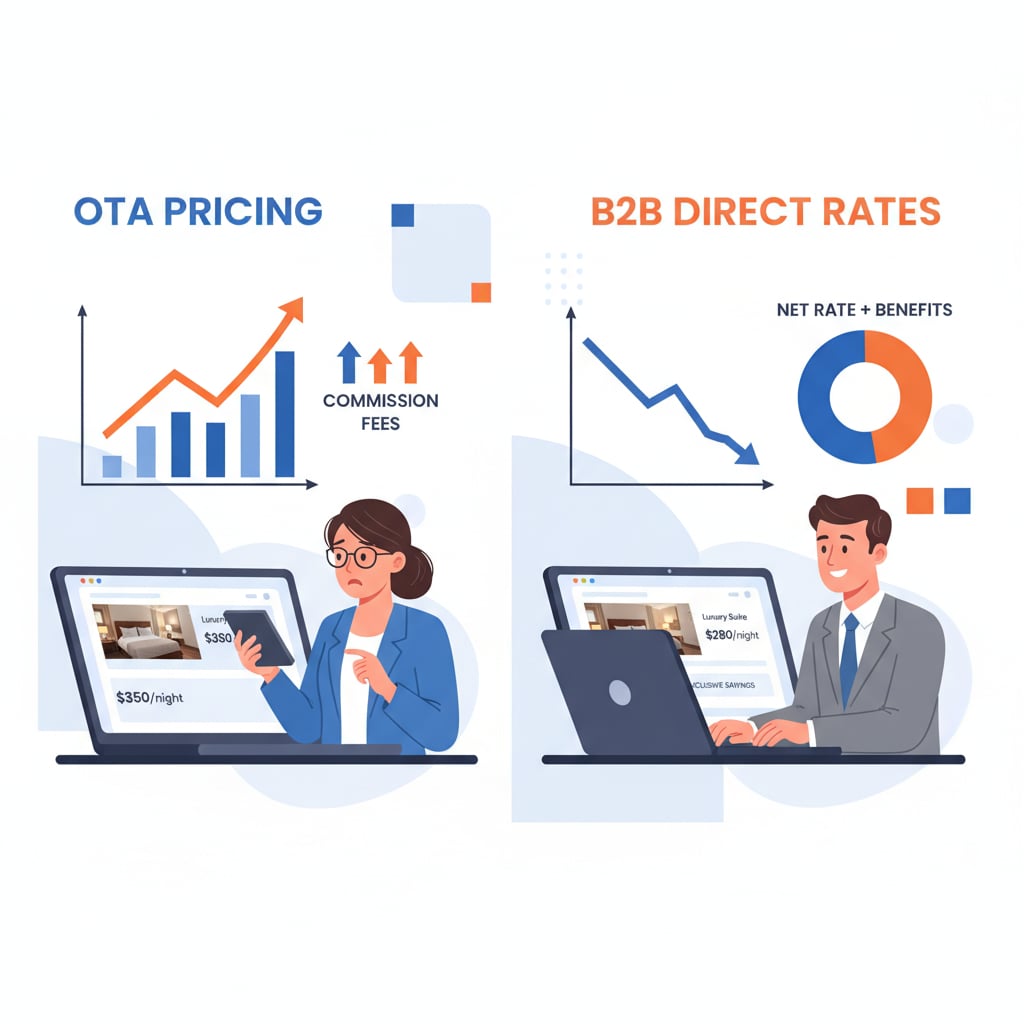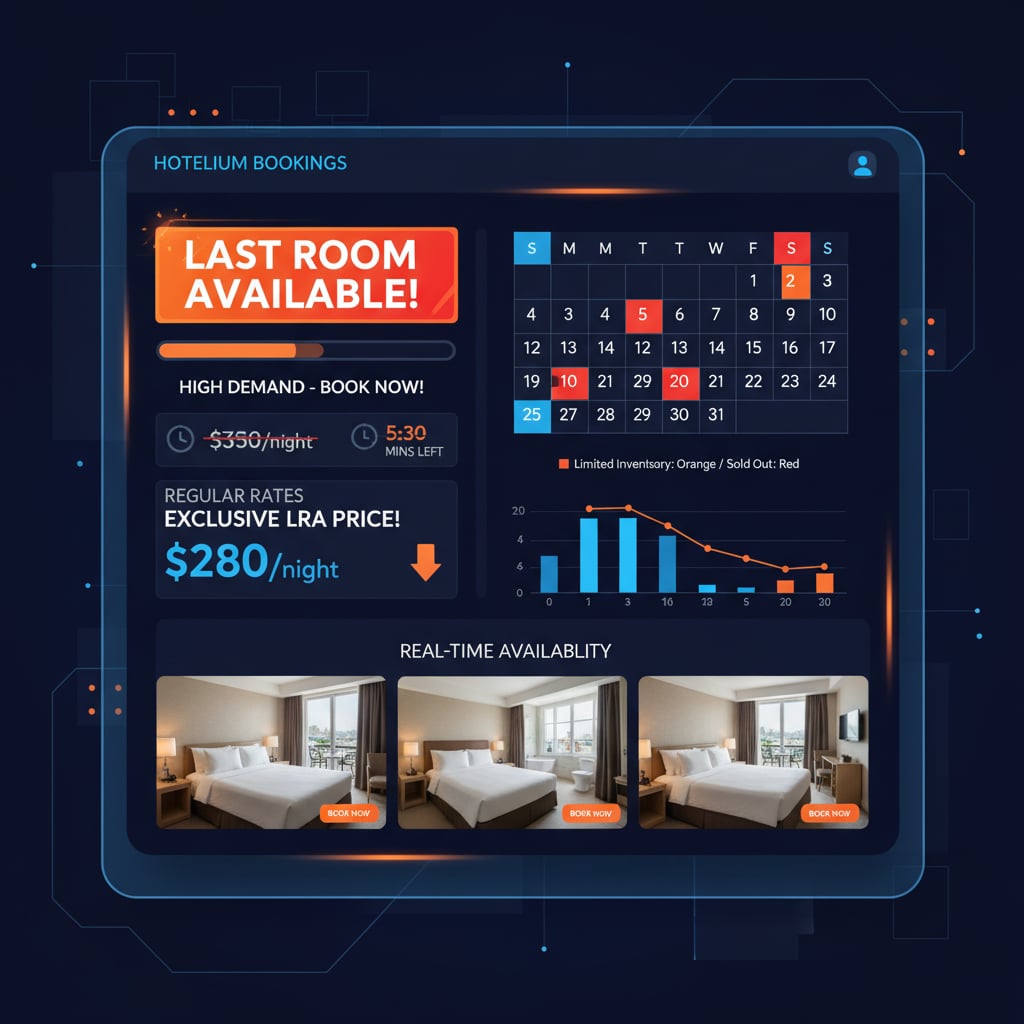
What is Last Room Availability?
Last Room Availability (LRA) is a hotel rate agreement where your contracted rate applies even when the hotel is selling its final available rooms. Unlike standard allotments that may be pulled when occupancy is high, LRA guarantees you can book at agreed rates regardless of remaining inventory.
Key principle: If the hotel has one room left to sell, you can book it at your contracted rate—even if the hotel's website shows $500 while your rate is $300.
LRA vs Standard Rate Contracts
| Feature | Standard Contract | LRA Contract |
|---|---|---|
| Availability Guarantee | Subject to allotment limits | Guaranteed if hotel has any rooms |
| Rate Stability | Fixed within allotment | Fixed at all occupancy levels |
| High Demand Periods | May be unavailable | Available at contracted rate |
| Premium vs Standard Rate | Better pricing (15-25% off rack) | Moderate pricing (10-18% off rack) |
| Booking Commitment | Often volume-based | Typically requires annual minimum |
How LRA Affects Pricing
The Premium Price Trade-off
Hotels charge higher base rates for LRA contracts because they're giving up revenue management flexibility. Here's why:
Standard contract scenario:
- Your rate: $200 (20% off $250 rack rate)
- When occupancy hits 85%, hotel pulls your allotment
- Hotel sells last 15% of rooms at $350-500 (dynamic pricing)
- Hotel maximizes revenue
LRA contract scenario:
- Your rate: $220 (12% off $250 rack rate)
- Even at 99% occupancy, you can still book at $220
- Hotel loses potential $350-500 revenue on your booking
- Hotel compensates with higher contracted rate
Real-World Pricing Examples
Example: Marina Bay Sands, Singapore (F1 Weekend)
| Booking Channel | Rate Type | Price | Availability |
|---|---|---|---|
| Hotel Direct | Best Available Rate (BAR) | $950 | Limited - 5 rooms left |
| OTA (Booking.com) | Public rate | $890 | 3 rooms available |
| Your Standard B2B | Allotment | SOLD OUT | Allotment exhausted |
| Your LRA Contract | Guaranteed rate | $650 | Available (LRA guarantee) |
Value delivered: You save client $240-300 vs public rates AND secure room when others are sold out.
Example: Budget Hotel, Kuala Lumpur (Low Season)
| Booking Channel | Rate | Notes |
|---|---|---|
| Hotel Direct (promotion) | $55 | Flash sale - 48 hours only |
| Your Standard B2B | $62 | Regular contracted rate |
| Your LRA Contract | $70 | Paying premium for guarantee you don't need |
Lesson: LRA costs more during low demand when you don't need guaranteed availability.
When LRA Makes Business Sense
✅ Situations Where LRA is Valuable
1. Predictable Peak Demand
Destinations with known high-occupancy periods:
- Singapore: F1 Grand Prix (September), National Day (August)
- Malaysia: Chinese New Year, Hari Raya, school holidays
- Thailand: Songkran (April), high season (Nov-Feb)
LRA ensures you can service clients when they most want to travel.
2. Corporate Travel Programs
When managing corporate accounts with unpredictable booking patterns:
- Last-minute business trips (48-72 hours notice)
- Conference attendees booking late
- Executive travel requiring specific hotels
Example: Corporate client sends 40 employees to Singapore quarterly. With LRA, you guarantee availability even when hotels are 95% occupied.
3. Group Travel Operations
Tour operators with confirmed departures:
- Guaranteed inventory for sold tour packages
- Avoid scrambling for rooms when groups are booked
- Sleep easy knowing you won't oversell packages
4. Limited Inventory Destinations
Markets where quality hotels are scarce:
- Island resorts with limited room count
- Historic city centers (limited new development)
- Boutique properties popular with your clients
❌ When LRA Doesn't Make Sense
1. Sporadic Bookings
If you only book 10-20 room nights annually, the LRA premium isn't justified. Standard on-request rates work fine.
2. Highly Flexible Destinations
Cities with abundant hotel inventory:
- Bangkok (over 1,000 hotels)
- Kuala Lumpur (plenty of mid-range options)
- Manila (competitive market)
You can always find alternative hotels at competitive rates.
3. Low Season Focus
If your bookings concentrate in low season, you're paying for a guarantee you don't need. Standard contracts offer better rates during these periods.
4. Price-Sensitive Clients
Budget-focused FIT travelers who prioritize lowest price over specific properties. They'd prefer you switch hotels to save $30/night rather than use expensive LRA rates.
Negotiating LRA Terms
Key Points to Negotiate
1. Rate Premium Cap
Standard ask: LRA rates 10-15% above standard contracted rates
Negotiate for: 5-8% premium with volume commitments
Example negotiation:
"We'll commit to 200 room nights annually if LRA premium is capped at 5%. At higher volumes (300+ nights), can we reduce to 3% premium?"
2. Partial LRA
Not all room types need LRA protection.
Propose tiered approach:
| Room Category | Contract Type | Rationale |
|---|---|---|
| Standard/Superior Rooms | LRA | High demand, frequently sell out |
| Deluxe/Premium Rooms | Standard allotment | Less demand, better availability |
| Suites | On-request | Rare bookings, no need to commit |
This reduces your overall cost while protecting high-volume categories.
3. Seasonal LRA
Negotiate LRA only for peak periods:
- Peak season (Nov-Mar): LRA rates apply
- Shoulder season (Apr-Jun, Sep-Oct): Standard contracted rates
- Low season (Jul-Aug): On-request rates (often better than contract)
This avoids paying LRA premiums year-round when you only need guarantee during high season.
4. Volume-Based Rate Tiers
Proposal structure:
| Annual Room Nights | LRA Premium | Additional Benefits |
|---|---|---|
| 100-200 nights | 12% above standard rate | LRA on Superior rooms only |
| 201-350 nights | 8% above standard rate | LRA on Superior + Deluxe rooms |
| 351+ nights | 5% above standard rate | LRA all room types + free upgrades |
5. Blackout Date Clarity
Some hotels try to exclude major events from LRA.
Get explicit clarity:
- Are there any blackout dates when LRA doesn't apply?
- If so, what alternative rates apply during blackouts?
- Can you get advance notice (90 days) of blackout declarations?
Ideal outcome: No blackouts, or maximum 10-15 blackout days annually with defined alternative rates.
Managing LRA Inventory
Booking Strategy
When to use LRA rates:
- Check standard availability first: If available, use cheaper standard rates
- Use LRA for confirmed bookings: Don't speculate with expensive LRA inventory
- Book close-in: LRA value increases as availability tightens (within 30 days)
- Verify actual need: Is client absolutely committed to this specific hotel?
Tracking LRA Utilization
Monitor these metrics to assess LRA contract value:
| Metric | Target | Action if Below Target |
|---|---|---|
| LRA bookings vs standard | 30-40% of bookings use LRA | If under 20%, negotiate seasonal LRA only |
| Avg savings vs BAR on LRA bookings | $50+ per room night | If under $30, reconsider LRA value |
| Peak season LRA usage | 60%+ of peak bookings | Good utilization during high value period |
| Low season LRA usage | Under 15% | If over 25%, you're overpaying in low season |
Alternative Strategies to LRA
1. Multi-Property Diversification
Instead of expensive LRA at one hotel, contract standard rates at 3-4 similar properties. When one is full, you have alternatives.
Example: Singapore marina area hotels:
- Marina Bay Sands (preferred, standard contract)
- Pan Pacific Singapore (backup option 1)
- Mandarin Oriental (backup option 2)
- Ritz-Carlton Millenia (backup option 3)
One hotel being full doesn't strand your booking.
2. Strategic Allotments + On-Request
Combine approaches:
- Core allotment: 100 nights soft allotment (best rates)
- On-request rates: For bookings beyond allotment (moderate rates)
- No LRA: Avoid premium pricing
You get volume benefits without LRA costs.
3. Dynamic Sourcing
Use B2B platforms that aggregate multiple suppliers:
- Check 5-10 suppliers for same hotel
- Each may have different availability
- Book whoever has inventory at best rate
Platforms like DMC Quote compare rates across multiple suppliers automatically, often finding availability without paying LRA premiums.
Case Study: When LRA Paid Off
Agency: Singapore-based corporate travel agent
Client: Tech company with 50 employees attending AWS re:Invent in Las Vegas
Challenge: Conference hotels sold out 3 months before event
LRA Contract in action:
- Contracted rate (LRA): $189/night at MGM Grand
- Public rates: $450-600/night (conference premium)
- Cost for 50 rooms × 4 nights: $37,800 vs $90,000-120,000 public rates
- Client savings: $52,200-82,200
- Agent commission (12%): $4,536
ROI on LRA: The 10% premium paid on LRA contract ($17/night extra vs standard contract) was trivial compared to $261-411/night savings vs market rates.
Common LRA Mistakes to Avoid
- Assuming LRA means unlimited inventory: Hotels can still be completely sold out (no last room to sell)
- Not verifying blackout dates: Discover major events excluded only when you need to book
- Overcommitting to LRA properties: Paying premium on hotels you rarely book
- Ignoring rate validity periods: LRA rates may increase annually; negotiate caps
- Not tracking utilization: Unable to justify renewal or renegotiation
Action Plan
- Analyze booking patterns: Which 5-10 hotels do you book most frequently during peak periods?
- Calculate LRA value: How often were those hotels unavailable when you needed them?
- Research peak pricing: What do those hotels charge during high demand vs your potential LRA rate?
- Proposal preparation: Approach hotels with volume data and LRA proposal
- Negotiate strategically: Seasonal LRA, partial LRA, or volume-tiered premiums
- Set up tracking: Monitor LRA utilization to assess value
Conclusion
Last Room Availability is a specialized tool for specific business needs—not a universal solution. It makes sense when you need guaranteed inventory during predictable high-demand periods, manage corporate accounts with last-minute bookings, or operate group tours requiring confirmed accommodation.
The key is negotiating smart LRA terms: seasonal application, reasonable premiums, and volume-based pricing that reflects your actual booking patterns. Track utilization to ensure you're getting value from the premium you pay.
For many agencies, a balanced portfolio—combining LRA at critical properties with standard contracts and dynamic sourcing—delivers optimal results. Use LRA where it truly adds value, not as a default approach.
Want access to competitive hotel rates with flexible booking options? Explore DMC Quote's hotel platform with multiple supplier options for every property.