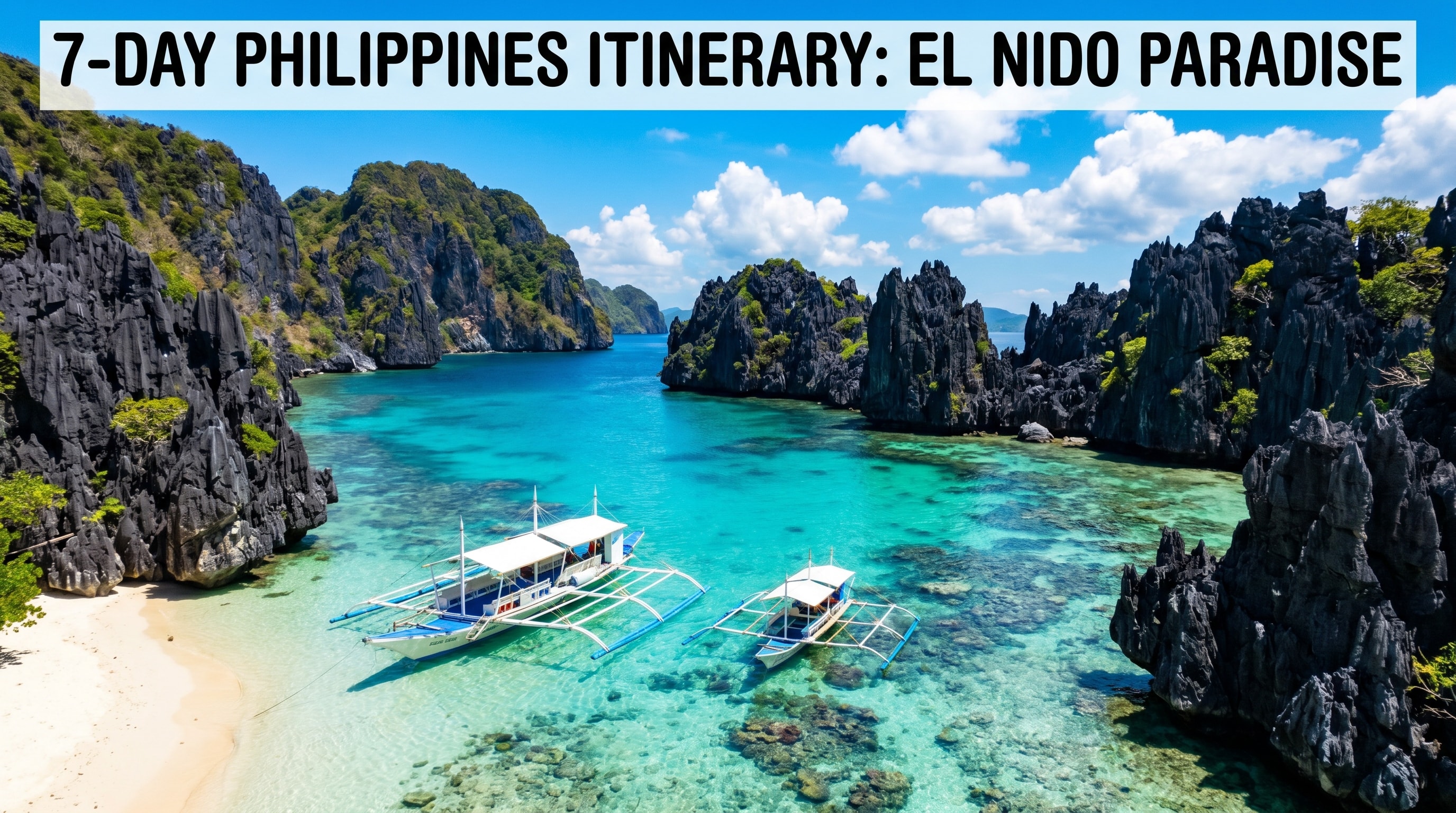
A great 7-day Philippines itinerary moves through three contrasting stops: a quick start in Manila, three days in Cebu for waterfalls and adventure, then three days of legendary island hopping in El Nido, Palawan. Because the country is 7,000+ islands, this route leans on cheap domestic flights to connect the dots — you'll fly twice, but each leg is short and the payoff is some of the most beautiful seascapes in Asia.
The Philippines runs on the peso (PHP) and is gentle on the wallet — budget around USD 65–120 per person per day mid-range. English is widely spoken, which makes it the easiest Southeast Asian country to navigate for first-timers. Here's the day-by-day route with the island-hopping tour breakdown, the flight logistics that make or break the week, and a full budget table in PHP and USD.
Philippines 7-Day Itinerary at a Glance
| Day | Location | Highlights |
|---|---|---|
| Day 1 | Manila | Intramuros, Rizal Park, arrival |
| Day 2 | Cebu | Fly to Cebu, city tour or Oslob transfer |
| Day 3 | Cebu (south) | Kawasan Falls canyoneering, Moalboal |
| Day 4 | Cebu | Whale shark note, sardine run snorkel, return |
| Day 5 | El Nido | Fly to Palawan, transfer to El Nido town |
| Day 6 | El Nido | Island Hopping Tour A (lagoons) |
| Day 7 | El Nido | Island Hopping Tour C, then fly out |
Day 1: Manila
Most international flights land in Manila (MNL), so spend the first day here. The historic core is Intramuros, the walled Spanish-colonial city — explore Fort Santiago (entry PHP 75) and San Agustin Church, ideally by the fun bamboo bike tour (Bambike, around PHP 1,500). Add Rizal Park and, if time allows, the National Museum complex (free). Manila's traffic is genuinely punishing, so don't over-schedule — keep your base near the airport or in Makati/BGC for dining and a smooth early flight out.
Days 2–4: Cebu
Take a morning flight to Cebu (CEB) — about 90 minutes, with AirAsia, Cebu Pacific and Philippine Airlines running constant service for PHP 1,800–4,500 (USD 32–80) one-way. Cebu is the Philippines' adventure hub. Day two you can do a quick Cebu City tour (Magellan's Cross, Basilica del Santo Nino, Fort San Pedro) before transferring south, or head straight to the southern coast where the real action is (a 3-hour drive).
The day-three highlight is Kawasan Falls canyoneering near Badian — a half-day of jumping, sliding and swimming through electric-turquoise gorges to a multi-tier waterfall. Guided trips run PHP 1,500–2,500 (USD 27–45) with gear and a local guide, and it's the single best adventure on this route. Base in nearby Moalboal, famous for its sardine run — millions of sardines swirling just off Panagsama Beach, snorkellable straight from shore.
Day four, snorkel the sardine run at dawn and visit the Pescador Island dive site, or do a turtle snorkel. A note on the Oslob whale sharks: while popular, the feeding-based interaction raises real animal-welfare concerns, and many responsible operators steer guests toward wild, non-feeding whale-shark encounters elsewhere (such as Donsol, in season) instead. Choose consciously. Fly out of Cebu to Palawan in the evening or early next morning.
Travel agents: Cebu canyoneering, island tours and El Nido boat trips are bookable as confirmed e-vouchers at net rates. Register free on DMC Quote to package the adventure days at margin.
Days 5–7: El Nido, Palawan
Fly to Puerto Princesa (PPS) or, if available, straight into the small El Nido airport. From Puerto Princesa it's a scenic but long 5–6 hour van transfer (PHP 700–900 shared) north to El Nido — book the El Nido airport if your budget allows to skip it. El Nido is the jewel of Palawan: towering limestone cliffs, hidden lagoons and water so clear it looks fake.
El Nido's island hopping is organised into standardised lettered tours (A, B, C, D), each visiting a different cluster. The two best are Tour A (the Big and Small Lagoons, Secret Lagoon, Shimizu Island) and Tour C (Hidden Beach, Matinloc Shrine, Helicopter Island, Secret Beach). Do Tour A on day six and Tour C on day seven morning if your flight is late, then transfer out. Each boat tour runs PHP 1,400–1,800 (USD 25–32) plus an eco-fee, and includes a fresh grilled-seafood lunch on a beach.
El Nido Island Hopping Tours Compared
| Tour | Best for | Highlights | Price (PHP) |
|---|---|---|---|
| Tour A | First-timers (most popular) | Big & Small Lagoons, Secret Lagoon, Shimizu | 1,400–1,600 |
| Tour B | Caves & beaches | Snake Island, Cudugnon Cave, Pinagbuyutan | 1,300–1,500 |
| Tour C | Dramatic scenery | Hidden Beach, Helicopter Island, Secret Beach | 1,500–1,800 |
| Tour D | Quieter, fewer crowds | Cadlao Lagoon, Paradise & Bukal Beach | 1,400–1,600 |
Tours A and C are the classic combo and cover the must-see lagoons. Bring reef-safe sunscreen, a dry bag and water shoes; the eco-tourism development fee (around PHP 200, valid 10 days) is required and checked.
Where to Stay (This Route)
| Place | Best area | Mid-range rate/night (USD) |
|---|---|---|
| Manila | Makati / BGC (or near airport) | 45–110 |
| Cebu | Moalboal / Badian (south) | 30–80 |
| El Nido | Town proper or Corong-Corong | 40–120 |
7-Day Philippines Budget Breakdown
| Category | Budget (USD) | Mid-range (USD) | Comfort (USD) |
|---|---|---|---|
| Hotels (6 nights, per person sharing) | 120 | 270 | 560 |
| Domestic flights (2 legs) | 90 | 140 | 240 |
| Tours (canyoneering, 2 island hops) | 90 | 130 | 200 |
| Food (7 days) | 70 | 140 | 270 |
| Transfers & local transport | 50 | 90 | 180 |
| Total per person | ~420 | ~770 | ~1,450 |
Excludes international flights. The two domestic flights are the cost that surprises people, so book them early.
Domestic Flight Logistics
This route hinges on two short domestic flights — Manila to Cebu, then Cebu to Palawan (Puerto Princesa or El Nido). The carriers are Cebu Pacific (cheapest, pay for bags), Philippine Airlines and AirAsia. Book 3–6 weeks ahead; fares swing wildly. Crucial planning note: El Nido's own airport (ENI) is tiny and served mainly by AirSwift at higher prices, but it saves you the long van transfer from Puerto Princesa. Weigh the time saved against the fare. Domestic flights are frequently delayed, so never book a same-day connection to an international flight — build a buffer night in Manila or Cebu.
Visa, Connectivity & Best Time to Visit
Citizens of many countries can enter the Philippines visa-free for up to 30 days (extendable), but check your passport's allowance before flying — see our Southeast Asia visa guide 2026. Buy a local SIM or eSIM (Globe or Smart) at the airport for cheap data; signal is patchy on the islands, so download maps offline. The dry season runs December to May — the ideal window, with March to May the sunniest for island hopping. The wet season (June–November) brings typhoons and rougher seas that can cancel boat tours.
Packing & Money Tips for the Islands
The Philippines is a beach-and-boat trip, so pack accordingly. Bring a dry bag (essential for the island-hopping boats, which get wet), water shoes for rocky lagoon entries, reef-safe sunscreen (regular sunscreen is banned at some protected sites), a rash guard for sun protection while snorkelling, and a quick-dry towel. A waterproof phone pouch saves a lot of heartbreak on the boats.
On money: the Philippines is largely cash-based outside big hotels. ATMs in El Nido are few, frequently out of cash, and charge high fees, so withdraw enough pesos in Cebu City or Puerto Princesa before heading to the islands. Carry small bills for tricycles, eco-fees and beachside meals. Power can be intermittent on smaller islands, so a power bank earns its place in your bag. With those basics sorted, the only thing left to plan is which lagoon to swim in first.
Filipino Food & Practical Tips
Filipino food is comfort cooking with Spanish, Chinese and Malay roots. Try adobo (the unofficial national dish — meat braised in soy and vinegar), sinigang (sour tamarind soup), lechon (roast suckling pig, Cebu's specialty and arguably the best in the country), kinilaw (Filipino ceviche), and halo-halo for dessert. Street and local meals run PHP 100–250 (USD 2–4.50). Carry cash — ATMs are scarce and often empty in El Nido, so withdraw in Cebu or Puerto Princesa first. Tipping around 10% is appreciated. Filipinos are famously warm and English is everywhere, which makes asking for directions easy.
Alternative Routes If You Have More Time
This Manila–Cebu–El Nido loop is the most efficient way to see the headline Philippines in a week, but the country rewards a longer trip. With 10 days, the natural add-on from Cebu is Bohol (the Chocolate Hills, tarsiers and the white sands of Panglao) by a quick ferry. From El Nido, an epic add is the El Nido to Coron expedition cruise — a 3-to-4-day boat journey through uninhabited islands, sleeping on remote beaches, that consistently ranks among the best trips in Asia.
Other strong swaps depending on the traveller: Siargao for surfers and a laid-back island vibe, Boracay for the classic powder-sand beach holiday (now better managed after its rehabilitation), and Banaue and Sagada in the northern mountains for the 2,000-year-old rice terraces and cool-climate scenery. The flexibility is the point — once you've got the domestic flight network figured out, the Philippines opens right up.
What Makes the Philippines Different
A few things set the Philippines apart from its mainland Southeast Asian neighbours. First, English is everywhere — it's an official language, signage and service are in English, which removes the friction first-timers feel in Thailand or Vietnam. Second, the warmth of the welcome is genuinely the headline: Filipino hospitality is famous for a reason, and you'll feel it from the first jeepney driver.
The trade-off is logistics. With 7,000+ islands, getting between places eats more time and money than a compact country like Singapore, and inter-island transport (flights, ferries, vans) can be delayed by weather. Build buffer time, book flights early, and accept that the journey is part of the adventure. Do that, and the lagoons of El Nido and the gorges of Kawasan more than repay the effort.
For Travel Agents: Packaging This Philippines Itinerary
Multi-island Philippines trips are some of the trickiest to quote — two domestic flights, van transfers, lettered boat tours, scarce inventory in El Nido. DMC Quote brings it together:
- Net hotel rates across Manila, Cebu, Moalboal and El Nido, including the hard-to-source El Nido properties.
- Instant e-vouchers for Cebu canyoneering and El Nido Island Hopping Tours A, B, C and D.
- Private transfers for the Puerto Princesa–El Nido leg and airport runs at confirmed rates.
- The AI package builder to chain the flights, hotels and tours into one branded quote in minutes.
Free registration, approved within 24 hours. Browse the B2B travel portal or create your free agent account to see live rates. For travellers combining the Philippines with the wider region, see our 2-week Southeast Asia itinerary.
Frequently Asked Questions
Is 7 days enough for the Philippines?
Seven days covers Manila, Cebu and El Nido well using two domestic flights. Because the country is so spread out, adding more islands (Bohol, Siargao, Boracay, Coron) needs 10–14 days to avoid spending the trip in airports.
How much does a 7-day Philippines trip cost?
Excluding international flights, budget around USD 420 per person for budget travel, USD 770 mid-range, and USD 1,450+ for comfort. The two domestic flights are the cost that surprises most travellers.
What are the El Nido island hopping tours A, B, C and D?
They're four standardised boat routes. Tour A (lagoons) is the most popular and Tour C (dramatic cliffs and hidden beaches) is the other must-do. B focuses on caves and beaches, D is the quietest. Each costs around PHP 1,400–1,800 plus an eco-fee.
How do I get from Cebu to El Nido?
Fly Cebu to Puerto Princesa or El Nido (Palawan). From Puerto Princesa it's a 5–6 hour van transfer to El Nido; flying into El Nido's small airport (AirSwift) is pricier but skips the long drive.
Should I do the Oslob whale shark experience in Cebu?
It's popular but the feeding-based interaction raises animal-welfare concerns. Many responsible travellers choose wild, non-feeding whale-shark encounters (such as Donsol in season) instead. Decide consciously.
When is the best time to visit the Philippines?
The dry season from December to May is ideal, with March to May the sunniest for island hopping. The wet season (June–November) brings typhoons and rough seas that can cancel boat tours.