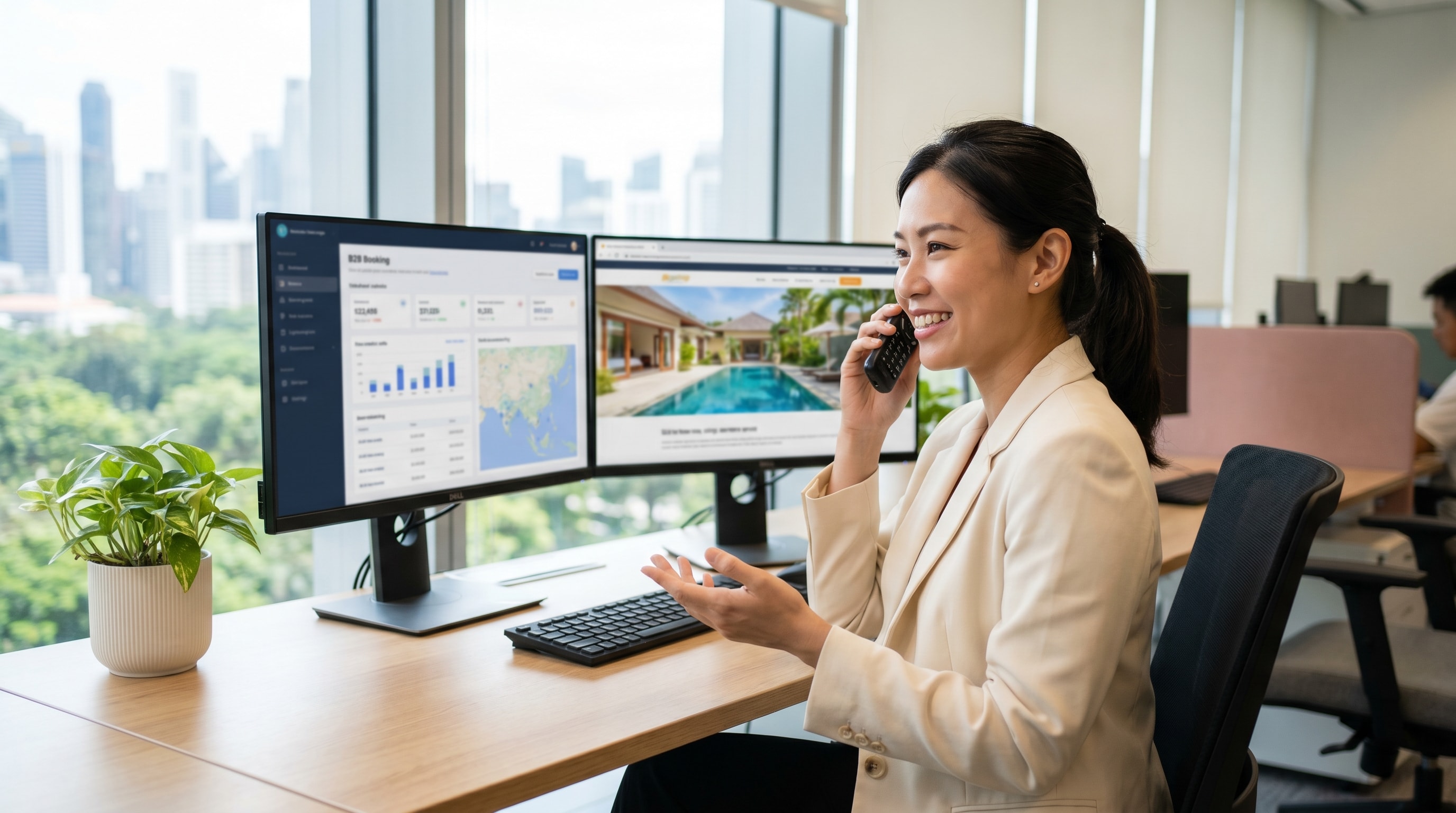
If you are a travel agent selling Bali in 2026 and still relying on OTA prices to quote your clients, you are leaving real money on the table. Booking.com, Agoda and Expedia are designed to keep margin inside their walls. Their published rate is the ceiling, not the floor. The floor sits with the DMC, and that is the rate you want.
If you book hotels for clients, our B2B hotel booking portal lists contracted net rates with instant confirmation.
This guide walks through how Bali B2B hotel booking actually works in 2026 — the contract structure, the rate types, how commission is built into agent rates, what payment terms to expect, and the practical traps that catch agents new to wholesale supply.
What "B2B Hotel Booking" Actually Means in Bali
A B2B hotel booking is a hotel reservation contracted between a wholesale supplier (a DMC, bedbank, or directly contracted property) and a registered travel agent. The agent receives a net rate — the rate the hotel is paid — and adds their own selling margin on top. The end client pays the agent, the agent pays the supplier, and everybody knows their number.
Compare that to an OTA booking. An OTA shows your client a public retail price. The OTA collects 10–18 percent commission. If you book through them, you are competing with their own retail page. There is no margin left for you. Bali B2B booking removes the OTA from the equation entirely.
Wholesale vs Published Rates in Bali — How the Gap Looks
Bali sits in a fragmented hotel market. There are roughly 4,800 properties operating across the island, ranging from one-bedroom homestays in Ubud to ultra-luxe villa estates in Uluwatu. The published rate gap from OTA to DMC typically runs 10–25 percent depending on season, hotel chain rules, and contract depth.
- 4-star Seminyak hotels — public rate around USD 130–180 per night, B2B net often USD 100–145
- 5-star Nusa Dua resorts — public rate USD 280–450, B2B net USD 220–360
- Ultra-luxe villa estates in Uluwatu — public rate USD 800–2,000+, B2B net 12–20 percent below
The exact gap depends on whether the hotel is on contract directly with the DMC, sourced through a Singapore or Indonesia bedbank, or pulled live from supplier APIs. Multi-supplier DMCs like DMC Quote consolidate inventory from contracted properties, regional bedbanks and direct-API suppliers — so the agent always sees the best of the available rates without juggling logins.
How Commission Is Built into Bali Agent Rates
There are two common commercial structures you will see in Bali B2B:
1. Net rate + agent markup
The DMC quotes a net rate. You decide the markup — usually 8–15 percent on hotels, 15–25 percent on tours and transfers. The agent margin is whatever you add. This is the most common and most flexible model.
2. Commissionable rate
The DMC quotes a "rack" rate and the agent earns a fixed commission (typically 8–10 percent) on the gross. The supplier handles the markup arithmetic. Less common in Bali; more common in Singapore and Hong Kong.
For Bali, net rates dominate because they let agents control the final selling price. A bachelor pad operator in Ahmedabad and a luxury concierge in Mumbai sell the same Conrad Bali room at completely different price points — both with healthy margin — because they set their own markup on the same net.
Why DMCs Beat OTAs on Margin
OTAs sell scale. They pay hotels less than DMCs do per room, but they keep the difference. You earn nothing from a Booking.com booking unless your client books through your affiliate link, and the affiliate cut is single-digit.
A B2B DMC sells you the room at the same wholesale price the OTA pays. Your margin is anywhere from 8 to 15 percent on hotels and significantly more on packaged add-ons (transfers, tours, dinners). On a 5-night Bali honeymoon at USD 2,500 net, an agent with a healthy 12 percent markup earns USD 300 per booking. Multiply that by 30 bookings a month in peak honeymoon season and you understand why selling Bali B2B beats reselling OTA links.
Payment Terms Indian Agents Should Negotiate
Most reputable Bali DMCs offer one of three payment models:
- Pay on confirmation — full payment at booking. Rare for established agents but common for first-time clients
- 30/70 split — 30 percent deposit at booking, 70 percent due 7–14 days before check-in
- Credit terms — invoice 7, 14 or 30 days after travel completion. Reserved for agents with track record and approved credit limits
For brand-new agents, expect to start on prepay and graduate to credit terms after 3–6 months of clean payment history. DMC Quote runs an agent-tier system where new accounts begin on Tier C (prepay) and move to Tier A (post-pay credit) once a relationship is established.
Instant Confirmation vs Request Rates
This is the operational detail that separates professional B2B platforms from spreadsheet-and-email DMCs.
- Instant-confirmation rates — book online, voucher issued in seconds. Available for most contract hotels and bedbank inventory. Best for honeymoons, families and any booking under 30 days out
- Request rates — supplier confirms within 4–24 hours. Common for villas, ultra-luxe resorts on free-sale, last-room availability, or peak-season requests
Modern Bali B2B platforms run hybrid inventory — instant confirmation where contractually possible, on-request only when the hotel demands it. Treat any DMC that quotes everything as "on request" with healthy skepticism. That signals shallow inventory and slow ground operations.
What to Look For in a Bali B2B Hotel Supplier
- Inventory depth — minimum 1,500+ Bali properties live in the search
- Multi-supplier integration — pulls from contract, regional bedbanks and direct hotel APIs
- Real-time availability — not yesterday-cached prices that fail at booking
- Voucher in seconds — automated voucher generation, no manual email loops
- Local ground support — actual humans on the ground in Bali for emergencies, no-shows, room re-allocations
- SGD or USD pricing — stable currency, not IDR daily volatility
- Markup-friendly UI — agent rate visible, no client-facing OTA page leaking the wholesale
Frequently Asked Questions
How much commission can I earn on Bali B2B hotel bookings?
Typical agent margin sits between 8 and 15 percent on hotel-only bookings, and significantly higher (15–30 percent) when bundled with transfers and excursions. The exact number depends on your markup discipline and the season — peak season margins compress, off-peak margins expand.
Can a small Indian travel agent access Bali B2B rates?
Yes. Most modern B2B platforms have removed the historical entry barriers. DMC Quote requires only a valid travel agency registration (IATA, TAFI, TAAI or equivalent) and basic KYC. There is no minimum monthly booking volume for the entry tier.
What is the typical OTA-to-DMC price gap on Bali hotels?
Across mid-scale and 5-star Bali properties, the wholesale-to-OTA gap runs 10–25 percent. The gap widens at the luxury end and during shoulder season. It narrows during peak December and Lunar New Year when most channels run flat rates.
Do Bali B2B rates include taxes?
By default, Bali B2B rates exclude the 21 percent service charge and government tax (10 percent VAT plus 11 percent service). Always confirm whether the quoted net rate is "net of tax" or "tax inclusive" before you build your client quote. Reputable DMCs display both.
How fast should a Bali DMC return a quote?
Instant for online inventory. For custom group quotes (10+ pax), expect a 24–48 hour SLA. Anything beyond 48 hours is a red flag in 2026 — modern DMCs run automation and should not take a week to price a 12-pax group.
Start Selling Bali Through DMC Quote
DMC Quote operates a multi-supplier B2B platform with thousands of Bali hotels live in real-time inventory, instant confirmation on most rates, and dedicated ground support across Denpasar, Seminyak, Ubud, Nusa Dua and Uluwatu. Read our guide to choosing the right Bali DMC or browse our top 20 Bali hotels for Indian agents to start.
Ready to access wholesale Bali rates? Explore our Bali inventory or register as an agent for instant access to net rates.