Group cruise bookings represent one of the highest-margin opportunities in travel agency operations, combining standard commissions with complimentary cabins, volume pricing advantages, and enhanced commission structures that can double or triple revenue per passenger compared to individual bookings. For agents seeking to build sustainable, profitable cruise practices, developing group booking expertise delivers exceptional returns.
A well-executed 32-passenger group booking on a 7-night Caribbean cruise can generate $8,000-$12,000 in total agent revenue—equivalent to 15-20 individual couple bookings while requiring similar overall effort. Understanding group booking mechanics, commission structures, and operational systems transforms agents from transactional bookers into high-value group coordinators commanding premium compensation.
Understanding Cruise Line Group Definitions and Benefits
Cruise lines define "groups" as minimum 8 cabins (16 passengers assuming double occupancy) booked under single contract with coordinated embarkation. Once this threshold is met, progressive benefits unlock as group size increases:
Standard Group Benefits (8-15 cabins / 16-30 passengers): Base commission on all paid passengers, reduced group rates (5-10% below published pricing), 1 complimentary cabin (16th passenger free on most cruise lines), group coordinator rate enabling discounted or free cabin for escort, deposit flexibility with extended payment schedules.
Enhanced Group Benefits (16-30 cabins / 32-60 passengers): All standard benefits plus 2 complimentary cabins, deeper group discounts (10-15% below published rates), onboard credit allocations ($50-$100 per cabin), possible cocktail party or group amenity, priority dining and activity reservations, dedicated group coordinator from cruise line.
Large Group Benefits (31+ cabins / 62+ passengers): Custom negotiated rates with potential 15-25% discounts, progressive complimentary cabin ratio (every 16th passenger), enhanced onboard credits ($75-$150 per cabin), possible cabin category upgrades, group-exclusive shore excursions or onboard events, potential additional commission percentages (1-2% above standard), dedicated account manager with direct cruise line access.
Group Revenue Calculation Examples
Example 1: 32-Passenger Caribbean Group (16 cabins)
- Average cruise fare: $2,000 per person
- Group discount negotiated: 12% ($240 per person savings)
- Group rate: $1,760 per person
- Total commissionable base: 30 paid passengers × $1,760 = $52,800
- Commission at 13%: $6,864
- 2 complimentary cabins (value $4,000 each)
- Complimentary cabin options:
- Option A: Sell comp cabins at $1,500 each (discounted) = $3,000 additional revenue
- Option B: Use comp cabins for escorts (reduces operational cost)
- Option C: Donate comp cabins for promotional purposes (marketing expense)
- Total agent revenue: $6,864 commission + $3,000 comp cabin sales = $9,864
- Effective commission rate: 18.7% of total group value
Example 2: 64-Passenger Mediterranean Group (32 cabins)
- Average cruise fare: $3,200 per person
- Group discount negotiated: 15% ($480 per person savings)
- Group rate: $2,720 per person
- Total commissionable base: 60 paid passengers × $2,720 = $163,200
- Commission at 14% (enhanced rate): $22,848
- 4 complimentary cabins (value $12,800 total)
- Sell 3 comp cabins at $2,200 each = $6,600
- Use 1 comp cabin for group coordinator
- Onboard credits: $100 per cabin × 32 = $3,200 value-add
- Total agent revenue: $22,848 + $6,600 = $29,448
- Effective commission rate: 18.0% of total group value
Group Booking Commission Structures by Cruise Line
Carnival Cruise Line: Base 10% commission scaling to 13% at VIP Chairman's Club. Group benefits: 16th passenger free at 8-cabin threshold. Additional 1-2% commission possible on groups 32+ passengers. Group amenities: onboard credits $25-$50 per cabin on groups 16+ cabins. Payment flexibility: 50% deposit at booking, balance 75 days prior.
Royal Caribbean International: Base 10-16% depending on tier status. Group benefits: 1 free passenger per 16 paid. Enhanced group rates available 12+ months advance booking. Large groups (32+ passengers) eligible for dedicated group coordinator and negotiated amenities. Flexible payment schedules negotiable on groups 20+ cabins.
Celebrity Cruises: Base 13-16% commission. Group benefits: 16th passenger free, potential cabin upgrades on groups 24+ passengers. Suite group bookings: 14-18% commission with enhanced amenities. Group onboard credits: $50-$100 per cabin on groups 16+ cabins. Concierge class and suite groups receive priority embarkation.
Princess Cruises: Base 12-16% commission depending on Commodore Club status. Group benefits: 16th passenger complimentary, group cocktail party available on 20+ passenger groups. MedallionClass connectivity enhances group coordination capabilities. Extended payment terms available: deposits as low as 10% on groups booked 18+ months advance.
Norwegian Cruise Line: Base 10-14% commission. Freestyle cruising benefits groups through flexible dining (no set seatings or tables). Group benefits: 16th passenger free, potential specialty dining credits on large groups. Haven suite groups receive exclusive amenities and priority access. Group shore excursion discounts: 10-15% on coordinated bookings.
Group Types and Target Markets
Affinity Groups: Organizations, clubs, or associations traveling together. Examples: alumni associations, hobby clubs, professional organizations, church groups, service organizations. Advantages: Built-in member base, shared interests facilitate bonding, often recurring annual travel. Marketing approach: Partner with organization leadership, attend member meetings, offer leadership incentives.
Family Reunions and Celebrations: Extended families gathering for milestones: anniversaries, birthdays, reunions. Advantages: Strong commitment levels, willing to pay premiums for convenience, appreciate coordination assistance. Challenges: Diverse age ranges requiring varied cabin categories, complex payment coordination, potential family dynamics. Marketing approach: Target milestone celebration opportunities, emphasize memory-making experiences.
Corporate Incentive Groups: Companies rewarding top performers or hosting team-building events. Advantages: Highest budgets, less price sensitivity, professional coordination expected. Challenges: Complex approval processes, specific brand requirements, detailed reporting needs. Marketing approach: Cultivate corporate travel manager relationships, highlight productivity and ROI benefits.
Special Interest Groups: Theme-based travel: wine enthusiasts, photographers, fitness devotees, cultural explorers. Advantages: Passionate participants, willing to pay premiums for specialized programming, strong word-of-mouth potential. Challenges: Specialized expertise required, custom programming coordination. Marketing approach: Partner with subject matter experts, highlight unique experiences unavailable individually.
Social Media and Online Community Groups: Bloggers, influencers, or online community members organizing follower travel. Advantages: Built-in marketing channels, younger demographics, social media promotion value. Challenges: Price sensitivity, less traditional booking patterns. Marketing approach: Offer influencer comp cabins, leverage user-generated content, provide shareable experiences.
Group Pricing Strategy and Negotiation
Effective group pricing requires balancing competitive rates that attract bookings with sustainable margins protecting profitability:
Early Booking Leverage: Cruise lines offer deepest group discounts for bookings made 12-18 months advance. Caribbean groups booked 15+ months out can negotiate 15-20% discounts versus published pricing. Use early booking deadlines to create urgency: "Lock in this rate by [date] before inventory releases to individual bookings."
Shoulder Season Opportunities: Groups traveling during off-peak periods negotiate superior rates due to cruise line need to fill inventory. September Caribbean groups or November Mediterranean groups can achieve 20-30% discounts plus enhanced amenities. Position as value opportunity rather than inferior timing.
Cabin Category Mix Strategy: Negotiate blended rates across cabin categories rather than single-category groups. Example: 40% inside cabins, 35% oceanview, 20% balcony, 5% suites creates pricing flexibility meeting varied budgets while maximizing total group revenue. Higher-category cabins improve overall commission despite some participants in lower categories.
Negotiable Elements Beyond Price: Onboard credits, speciality dining allocations, beverage package discounts, shore excursion credits, cabin upgrades, late final payment dates, reduced deposit requirements. Sometimes achieving $100 onboard credit per cabin proves easier than direct price reduction while delivering equivalent perceived value.
Group Operational Systems and Tools
Group Booking Software: Specialized systems like GroupSync, CruiseSheet, or cruise line proprietary portals enable efficient group management. Capabilities: centralized passenger manifests, automated payment tracking, room assignment management, communication tools, document distribution. Investment: $50-$200 monthly depending on features and group volume. ROI: Reduces administration time by 60-70% versus manual spreadsheet management.
Payment Collection Systems: Implement systematic payment processes preventing cash flow challenges and delinquent bookings. Best practices: Require non-refundable deposits (15-25% of total) at initial booking, establish milestone payments (50% at 120 days, balance at 75 days), accept credit cards for easy collection (factor processing fees into pricing), automated payment reminders 30-60-90 days before deadlines.
Communication Platforms: Establish dedicated group communication channels: private Facebook groups for casual Q&A and excitement building, email listservs for official communications and documentation, WhatsApp or GroupMe for real-time coordination during travel. Regular touchpoints: monthly updates during planning phase, weekly updates final 30 days, daily updates during travel for on-ship coordination.
Documentation Systems: Create comprehensive group documentation packages: detailed itineraries with daily programming, cabin assignment rosters, dining reservation schedules, shore excursion manifests, emergency contact lists, ship maps and deck plans, packing lists and travel tips. Professional documentation reduces pre-trip questions by 50-60% while enhancing perceived value.
Group Marketing Strategies
Themed Group Development: Rather than generic "cruise groups," create themed experiences attracting passionate participants: Wine Lovers Mediterranean Cruise, Photography Adventure Alaska, Wellness Retreat Caribbean, Culinary Journey Asia. Themed groups command 10-20% pricing premiums while generating stronger commitment and word-of-mouth marketing.
Early Bird Incentives: Reward early commitments driving momentum: "First 10 bookings receive $100 onboard credit and cabin upgrade priority." Early bookings create social proof encouraging fence-sitters. Establish clear deadlines creating urgency: "Early bird rate expires December 1st."
Referral Programs: Incentivize group members to recruit additional participants: "Book a friend and both receive $50 onboard credit." Successful programs convert group members into marketing ambassadors. Track referrals systematically ensuring promised incentives are delivered.
Information Sessions: Host in-person or virtual group kickoff meetings showcasing itinerary, reviewing ship features, explaining booking process, and answering questions. Information sessions convert 30-50% of attendees into bookings versus 5-10% for cold outreach. Include ship videos, sample menus, and virtual tours creating excitement and visualizing experiences.
Risk Management and Contracts
Group Contracts and Terms: Clearly document group booking terms protecting both agency and participants: cancellation policies and penalties, payment schedules and deadlines, cabin assignment procedures, responsibility for individual passenger documentation, travel insurance requirements, behavior and conduct standards. Have legal counsel review contracts ensuring enforceability.
Travel Insurance Requirements: Strongly recommend (or require) comprehensive travel insurance covering trip cancellation, medical emergencies, and evacuation. Group cancellations or medical emergencies without insurance create significant liability and service challenges. Some agents include basic insurance in group pricing, positioning as value-add while ensuring coverage.
Deposit Protection: Charge non-refundable deposits sufficient to cover cruise line penalties if group participants cancel. Typical structure: 20-25% non-refundable deposit at booking, additional 25% at 120 days (partially refundable if replaced), balance 75 days prior (non-refundable). Graduated structure protects agency while maintaining booking flexibility.
Attrition Clauses: Understand cruise line attrition policies protecting guaranteed cabins. Most groups must maintain 80-90% of contracted cabins or face penalties. Build buffers booking 2-3 extra cabins beyond minimum to accommodate potential cancellations without falling below thresholds.
On-Ship Group Coordination
Group Escort Value: Personally escorting groups or hiring professional escorts significantly enhances experience quality and agent reputation. Escort responsibilities: welcome reception coordination, dining reservation management, shore excursion logistics, problem resolution, social activity facilitation. Compensation: Use complimentary cabin for escort, charge professional escort fees ($100-$200 per day), or position as value-add justifying higher group pricing.
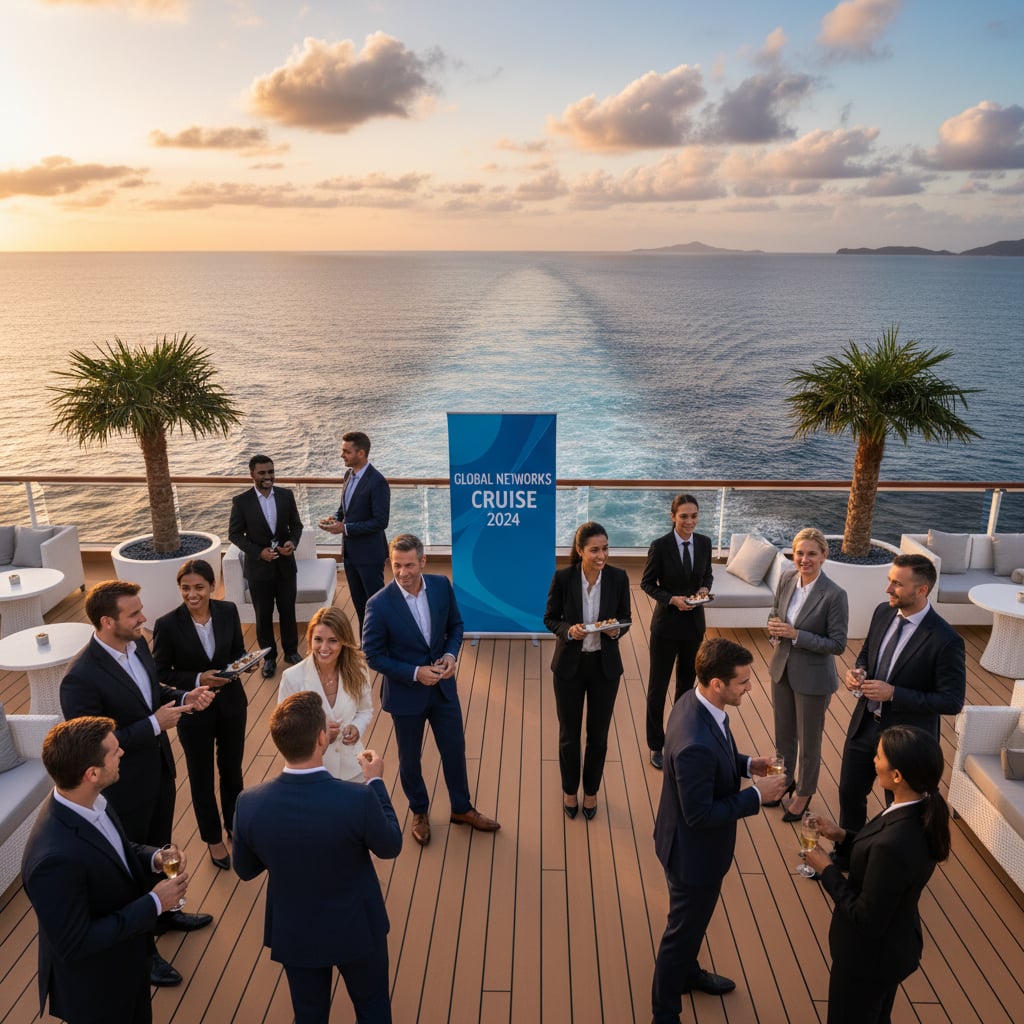
Group Amenities: Coordinate special touches enhancing group experience: welcome aboard cocktail reception, group photo opportunities, specialty restaurant reservations, shore excursion coordination, farewell gathering. Amenities create memorable moments generating referrals and repeat group business. Many amenities available through cruise line at no cost for groups 16+ passengers.
Social Programming: Facilitate group bonding through organized activities: meet-and-greet sessions, themed dinners, trivia competitions, shore excursion debriefs. Balance structured programming with free time. Optional activities allow participation flexibility accommodating diverse preferences.
Post-Group Follow-Up and Repeat Business
Immediate Post-Cruise Outreach: Within 7-10 days after return, contact group participants gathering feedback, thanking for participation, and requesting testimonials. Timing capitalizes on positive emotions before memory fades. Simple survey: rate overall experience 1-10, highlight favorite moments, suggest improvements, indicate interest in future group travel.
Photo and Memory Sharing: Create shared photo albums (Google Photos, Dropbox) enabling participants to contribute and download memories. Group photos reinforce positive associations and provide ongoing touchpoints. Encourage social media sharing with branded hashtags extending marketing reach.
Future Group Planning: Successful groups generate strong repeat potential. Survey interest in future trips: same destination annually, new destinations, expanded group including friends/family. Repeat groups require 50-60% less marketing effort than new groups while demonstrating higher commitment rates. Some agents build business models around annual group programs with established client bases.
Conclusion: Building a Group-Focused Practice
Group cruise bookings transform agency business models from high-volume, low-margin individual transactions to lower-volume, high-margin coordinated experiences. A single successful 40-passenger group generates revenue equivalent to 20+ individual couple bookings while requiring similar aggregate effort when systems and processes are established.
Success requires moving beyond transactional booking to comprehensive group coordination, combining negotiation skills, operational systems, marketing expertise, and client service excellence. The most profitable group specialists focus on 2-3 groups annually rather than attempting dozens, ensuring each receives attention and coordination delivering exceptional experiences that generate referrals and repeat business.
Group bookings also provide natural opportunities for comprehensive travel packages, combining cruises with pre/post hotel stays, group transfers, and coordinated shore excursions maximizing revenue per participant while delivering superior value.
Ready to develop your group cruise program? Contact DMC Quote for group coordination resources, supplier relationship development, and operational system recommendations tailored to your agency specialization goals.