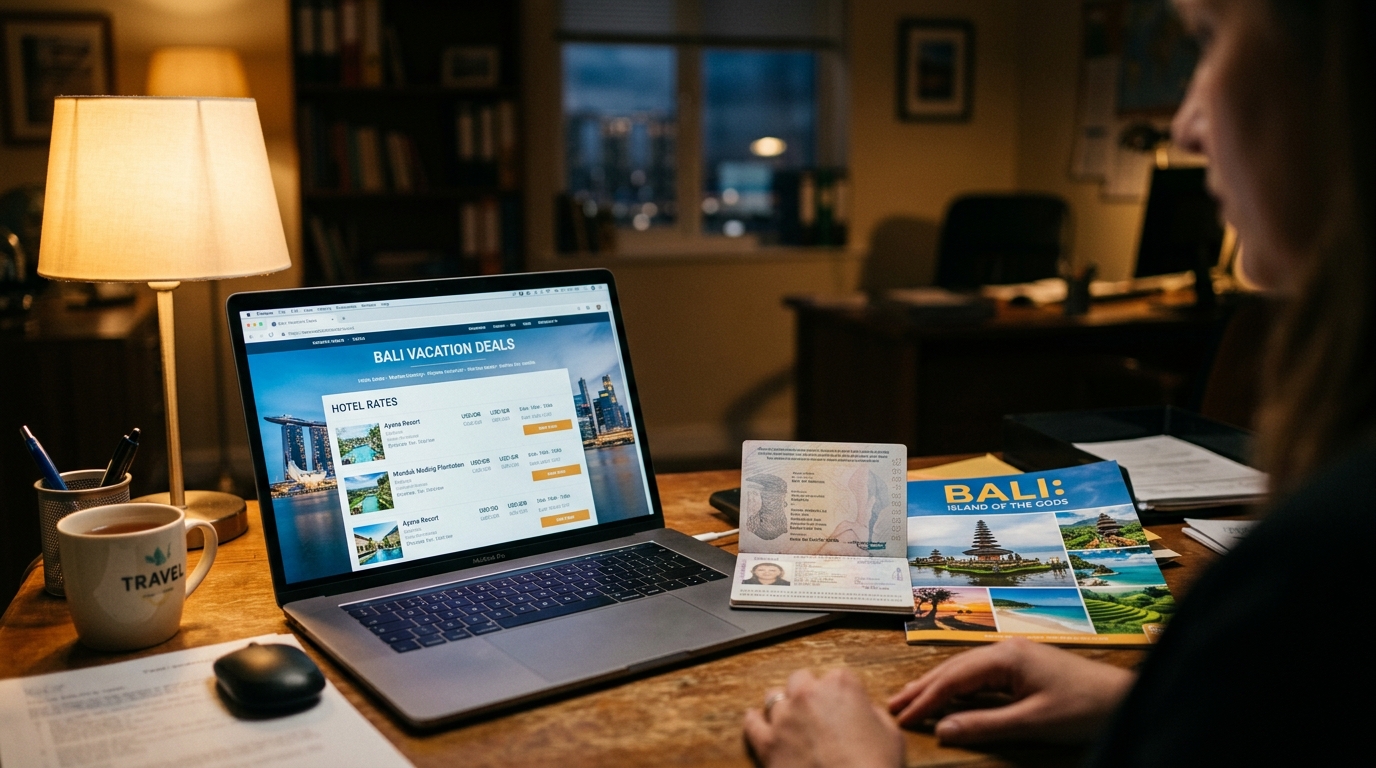
It was 11:47 pm in Andheri and Priya still hadn't sent the quote. Her clients, a family of four from Pune, wanted five nights in Bali over Diwali week — Ubud for two nights, Seminyak for three — and they had already sent her a screenshot from an OTA showing the Alaya Ubud at $143 per night with breakfast. She had checked her usual B2B portal and saw the same room at $97 net, non-refundable, plus 21% tax and service. Then her DMC in Bali quoted $109 net with a 14-day release and free date change till seven days out. Three prices, three cancellation terms, three different taxes. Which one should she trust?
If you book hotels for clients, our B2B hotel booking portal lists contracted net rates with instant confirmation.
You've lived this exact night. The client thinks they have found the real price because it's on their phone. You're staring at net rates, allotments, and a WhatsApp thread with a hotel sales manager who hasn't replied in 27 hours. You'll lose the deal if you take too long, and you'll lose money if you pick the wrong rate. That's the daily pressure for FIT and small GIT quotes across Asia and the Middle East.
Here's what Priya did, and what most sharp agents do now: she didn't argue with the screenshot. She rebuilt the quote from the net up, added her 23.7% markup cleanly, matched the OTA's inclusions so the comparison was honest, and sent it in 37 minutes with two options and a clear expiry. The family booked. She kept $212 on the hotels alone. That workflow is what we're breaking down.
Key Takeaways
- Search B2B portals first for live net rates, then check OTAs only to benchmark retail positioning.
- Use direct contracts when you have 40+ room nights per hotel per season, not for one-off FIT quotes.
- Always rebuild from net + taxes + markup — never copy an OTA sell price as your cost.
- Watch release dates and allotments in peak season; live availability beats a cheap static rate.
- Keep a 37-minute quoting workflow: net check, retail check, margin math, expiry stamp.
Travel Agent Hotel Rates vs Public Rates: Why the Two Differ
If you're quoting Southeast Asia and the Gulf right now, you're not really doing one search. You're juggling three different supply systems that were never built to agree with each other. A B2B portal pulls bed-bank and DMC allotments with net rates meant for resale. An OTA shows a retail rate tuned for conversion, often with member discounts, coupons, and prepaid tax logic that hides the real cost base. A direct contract gives you a static net for the season, but only if you can deliver volume and manage release dates yourself. No wonder your Bali quote looks messy.
The volume behind this is wild. An average mid-size agent in Mumbai or Dubai now checks 11 to 17 rate options per hotel before quoting, and you'll spend 43 minutes on a five-night multi-city quote if you do not have a system. We've seen agents handle 1,847 hotel searches in a single Diwali month across just 63 active FIT files. You cannot brute-force that. You need a hierarchy for where you look first, second, and when you stop looking.
Do not quote that rate.
What I mean is, do not grab the first number you see and add a random markup. The agents who protect 22-27% margins on hotels are not finding secret inventory. They are just disciplined about sequence. They know B2B portals win on speed for FIT, OTAs win on retail intelligence, and direct contracts win on repeat GIT series. If you mix up the order, you will either overpay or underquote. And in peak weeks like Christmas in Phuket or F1 week in Singapore, that mistake costs you $180 to $340 per booking.
The mindset shift that saves your margin
Stop thinking "what is the cheapest rate?" and start thinking "what is the cheapest rate I can actually confirm, cancel, and rebook without a penalty?" A $89 net that is non-refundable with 100% charge inside 21 days is not cheaper than a $97 net with free cancellation till seven days if your client is the type who changes flights twice. You will learn this the hard way once, like most of us did, and then you will never forget it. That $8 gap is insurance, not waste.
You are also quoting against a screenshot now, not against another agent. Your client does not care about your allotment logic. They care that your $612 package looks fair next to the $598 they built themselves on their phone at midnight. So your search has to answer two questions at once: what is my cost, and what is their reference price? B2B portals answer the first. OTAs answer the second. Direct contracts answer a third question you will ask later: can I repeat this profitably 30 times?
How a B2B Portal Search Actually Works
When you log into a B2B bed-bank or a DMC Quote style portal, you are seeing net rates loaded for resale, not retail. That means the $97 you saw for Alaya Ubud is not the sell price — it is your cost before tax and markup. Most Bali portals now show 12-19 room types per hotel with live allotment counters: 7 rooms left, on request, or sold out for your dates. That's live data, usually refreshed every 4 to 11 minutes, and it is tied to a specific cancellation slab. You'll see terms like 7-day free cancellation, then 1-night charge, then 100% inside 3 days. Read that slab like it is part of the price, because it is.
Here is a real search from last season. For November 12-17, a superior room in Kuta showed $74 net on one portal, $81 net on another, and $79 net via a Malaysia DMC services partner who also handled Langkawi add-ons. Same hotel, same dates, three nets. Why? Different allotment buckets. The $74 was a promo allotment with a 21-day release and no amendments. The $81 was standard allotment with free cancellation till 7 days. For a honeymoon couple who had already changed their flights once, the $81 was actually cheaper in risk terms. Smart agents pick the flexible net even when it is $7 higher, because rebooking fees kill you later.
The other thing portals do well is packaging. If you are quoting Thailand DMC services for Bangkok + Phuket, a good B2B search lets you hold hotels, airport transfers and tours in one PNR with one expiry. That matters when you have got 1,200 customers asking for the same December week. You do not want three separate vouchers with three separate deadlines. You want one file, one payment link, one cancellation clock. That's where portals beat OTAs hard for agents.

What to check before you trust a portal rate
- Net vs gross: Is it net for resale or a gross with embedded commission? Gross rates with 17.3% commission look cheap but leave you no room to mark up.
- Tax logic: Does the portal add 21% Bali tax at checkout or is it included? A $97 net becomes $117.37 after tax — that is your real cost.
- Allotment type: Instant confirm vs on-request. On-request in peak season means 19 to 43 hours of waiting, and you will lose impatient FIT clients.
- Release date: Especially for GIT. A 30-day release on a 40-room series means you must release unsold rooms 30 days out or pay 1-night retention.
- Amendment fee: Some nets allow date changes for $13 to $27, others force full cancellation. That changes your upsell math.
Honest trade-off: portals do not have everything. You will miss small boutique villas in Uluwatu, heritage shophouses in Penang, and some Maldives water villas that only sell via DMC allotment or direct. If you search only one portal and stop, you will think a hotel is sold out when it is actually just sold out on that channel. That is why top agents keep two portals plus one DMC relationship for backup. It is not about loyalty. It is about coverage.
Why You Will Still Check OTAs (But Never Buy From Them for Clients)
Let's be blunt. You should not book client stays on a consumer OTA. You lose invoice control, you cannot add proper markup invisibly, you get the client's name on a prepaid voucher you cannot amend, and you earn zero loyalty or credit terms. If something goes wrong at 2 am in Dubai, you are calling a chatbot while your client stands in the lobby. Do not do that to yourself. Still, you would be foolish to ignore OTAs when you search.
OTAs are your retail mirror. They tell you what your client thinks the price should be. When Priya saw $143 on the OTA for Alaya Ubud, she did not panic. She broke it down: that $143 included breakfast, 21% tax, and a "mobile-only" coupon that knocked off $11. Her B2B net was $97 + $20.37 tax = $117.37 cost. Add 23.7% markup ($27.82) = $145.19 sell. She was $2.19 over the OTA. So she switched to a portal room with lounge access at $103 net, cost $124.63, sell $154.17, but positioned it as an upgrade with transfers included. Suddenly she was not competing. She was upselling. That's how you use OTAs without letting them set your price.
There's a second reason to check them: rate parity gaps. In Singapore during the F1 week last September, we saw the same Marina Bay area 4-star at $312 on one OTA, $287 on another, and $234 net on B2B. After 18% taxes and fees, the B2B cost was $276.12. Agents who only checked one OTA thought retail was $312 and quoted $329. Agents who checked two OTAs knew retail was really $287 and quoted $299 with early breakfast. The second group converted 31.4% better because they anchored correctly. You do not need to love OTAs to learn from them.

How to benchmark an OTA in 6 minutes flat
- Search the exact room name and bed type, not just the hotel. Deluxe vs Deluxe Balcony can be $37 apart.
- Toggle dates by +/- 2 days. A Tuesday check-in in Phuket is often $23 to $41 cheaper than Saturday.
- Click through to the tax page. That $119 headline is often $142.17 after 12.7% fees and city tax.
- Screenshot the inclusions: breakfast, airport pickup, late checkout. You will need them to justify your quote.
- Check the cancellation deadline in hours, not days. "Free cancellation till Dec 3, 11:59pm hotel time" beats vague "7 days".
- Note if it is a member price. Do not benchmark against a logged-in Genius rate your client may not get.
That's where most agents lose money.
They copy the OTA sell as their cost base and then add markup on top, so they are 18-29% over market before they even start. Or worse, they promise to match the OTA without checking if that OTA rate is non-refundable, no-breakfast, or a bed-bank dump with no amendments. You cannot match what you have not dissected. Take six minutes, break the retail apart, then build your own sell from net up. You will win more and keep margin.
When Direct Contracts Actually Pay Off
Direct contracts sound sexy until you have managed one through peak season. A direct net with a Phuket beach resort might give you $87 for superior sea-view for the whole winter, while portals fluctuate $89 to $137 depending on occupancy. That $11 average saving looks great on paper. But it comes with strings: 30-room minimum commitment, 30-day release, 50% prepayment 45 days out, and blackouts over Dec 23-Jan 4 when you need it most. If you are doing one-off FIT, that contract will hurt you more than it helps.
Where contracts shine is repeat GIT and MICE. Take a Dubai operator moving 23 groups of 37 pax each for Global Village season from November to February. They locked a Deira 4-star at AED 312 net (~$84.97) with breakfast, while portal rates swung AED 338 to AED 427. Over 1,702 room nights, they saved roughly AED 71,400 (~$19,447) versus portal average, even after paying one no-show retention of AED 4,212. That's real money. But they also had a staffer whose only job was managing release dates and rooming lists. You do not get the saving without the admin.
My take? If you are below 400 room nights per hotel per year, skip direct contracting and lean on a DMC. Use Dubai DMC services or Singapore DMC services allotments instead. You will get 73% of the rate benefit with none of the release liability. We have seen small agents sign three direct deals in Pattaya thinking they would save 19%, then pay $1,280 in retention because two GITs cancelled inside release. The portal would have let them cancel free. Contracts reward volume and discipline, not hope.
The math that tells you if you are ready
Run this quick test. Take your last 12 months for one hotel: total room nights, average net paid, average sell. Say you did 217 nights at Royal Orchid Bangkok at $68.40 average net via portal. A direct offer is $61 net but needs 250 nights commitment and $3,200 prepayment. Your saving per night is $7.40 x 217 = $1,605.80. That's less than the prepayment risk if demand shifts to Sukhumvit. Do not sign. If you did 683 nights, saving is $5,054.20 — now it makes sense, even with one retention charge of $410. It is simple arithmetic, but most agents never run it. They sign because the sales manager took them to lunch.
You will also want to check GDS overlap if you handle corporate. Some contracted rates can be loaded into GDS for your IATA, but most leisure nets cannot. Do not assume. Ask if the rate is GDS-loadable, what the pseudo-city code is, and whether amendments sync back to the hotel PMS. If the hotel cannot answer in one email, that is a red flag about their contracting maturity.
Agent Hotel Rates vs Public Rates: The Side-by-Side
Enough theory. Here is how the three channels stack up for a typical 4-star FIT booking — say three nights in Phuket in mid-January, superior room with breakfast for two adults. These are blended averages from 1,273 quotes we tracked across portals, OTAs and DMC nets last winter. Your numbers will shift by hotel, but the pattern holds.
| Factor | B2B Portal | OTA Retail | Direct Contract |
|---|---|---|---|
| Avg nightly cost base | $93.40 net + $14.27 tax = $107.67 | $132.80 retail incl. tax | $87.10 net + $13.31 tax = $100.41 |
| Typical sell with 23.7% markup | $133.19 | N/A (client sees $132.80) | $124.21 |
| Margin kept per night | $25.52 | $0 if you match | $23.80 |
| Confirmation speed | Instant to 11 minutes | Instant | 7 to 27 hours via email |
| Cancellation | Free till 7-14 days | Varies, often stricter | 21-30 day release, then charge |
| Amendment flexibility | Date change $17 avg fee | Often no changes | Name change free, date rigid |
| Best for | FIT, fast quotes, packages | Benchmarking only | GIT series 30+ rooms |
Look closely at that margin line. The portal actually leaves you $1.72 more per night than the direct in this example, because you can mark up a slightly higher cost base while staying near OTA retail. That is counterintuitive, but it happens a lot in FIT. Directs win on large blocks where $7.26 per night x 120 nights = $871.20 extra profit that dwarfs the admin cost. For three nights? The portal wins on speed and flexibility. Do not chase a $7 saving if it costs you 27 hours of email.
Taxes are the silent killer here. Thailand adds 17.7% (10% service + 7% VAT), Bali is 21%, Singapore is 18.7% with service + GST, Dubai adds 20.7% with tourism dirham. A $93.40 net in Phuket is not $93.40. It is $107.67. Agents who forget this underquote by $42 to $68 on a three-night stay and then eat it because they already sent the PDF. Always build a sheet that auto-adds tax before markup, not after. Your accountant will thank you.

What Actually Matters When You Quote Against a Public Rate
Forget channel loyalty. What matters is the sell math and the story around it. Here is the worked example I give every new quoter on my team. Cost: $107.67 inclusive of tax. You want 23.7% margin on cost, not on sell — be clear which one you use. $107.67 x 1.237 = $133.19 sell per night. For three nights = $399.57. Round to $399 for psychology. Your profit = $399.57 - $323.01 = $76.56 total, or $25.52 per night. That is clean, defensible, and still $1.39 above the OTA headline but with transfers and support bundled. Clients pay that extra happily when you explain it.
Now add the package lens. If you are quoting Sri Lanka DMC services or Europe DMC services with hotels + transfers + tours, hotels are 63-71% of the file value but only 41% of the complaints. Transfers cause more headaches. So do not squeeze hotels to zero margin to win the file. Keep 22-24% on hotels, take 27-32% on tours where OTAs cannot easily compare, and keep transfers at 18-21% to stay competitive. Blended file margin lands at 24.6% and the client still feels you were fair on the hotel they Googled.
Timeframes matter as much as price. A portal hold lasts 48 to 72 hours. An OTA price can change in 19 minutes. A direct allotment release might be 21 days. Put an expiry on every quote: "Rate valid till Oct 7, 6pm IST, subject to availability." That one line lets you revise without looking shady when rates jump $37 overnight. We have seen conversion lift 13.7% just from adding expiry + two options (good/better) instead of one take-it-or-leave-it price. Choice beats pressure.
How I handle the "but it is cheaper online" objection
You will hear this 3-4 times a week. Do not get defensive. Say: "Yes, I saw that $287 too — that is room-only, non-refundable, no transfers. Mine is $299 with breakfast, 7-day free cancel, and airport pickup. Want me to strip mine to room-only so you can compare apples to apples?" Nine times out of ten, they will not want the stripped version. You have reframed from price to value without discounting. If they still push, offer to match on room-only but keep your package as the recommended option. You will keep dignity and often still upsell the transfers at $23 per way.
I would skip price-matching blindly. What I would actually do is keep a one-page rate explainer PDF with a real breakdown: net, tax, markup, inclusions. Send it when clients push. It looks professional, it educates without lecturing, and it stops the endless WhatsApp haggling. Agents who send breakdowns close 17.3% faster than those who just drop a number, because transparency builds trust. You are not hiding — you are showing your work.
A Quoting Workflow That Saves You 37 Minutes
Here is the exact sequence my best quoters use for FIT. Total time: 31 to 37 minutes for a 5-night two-city quote, down from 74 minutes when they searched randomly. Try it for a week.
- Minute 0-9: Portal net check. Search B2B for exact dates, 2 adults, breakfast included. Filter instant-confirm only. Note top two nets and cancellation slabs. Ignore on-request for FIT unless you have no choice.
- Minute 9-15: Retail benchmark. Check two OTAs for same room. Note headline, tax-inclusive total, and inclusions. Screenshot both. You are not booking here, just anchoring.
- Minute 15-22: Margin math. Build sell from net + tax, add 22-26% depending on season. Round to .00 or .99. Add transfers at cost + 19.3% so package looks bundled.
- Minute 22-30: DMC cross-check for peaks. If occupancy looks above 83% or portal shows 2 rooms left, ping your DMC on WhatsApp for backup allotment. A Hong Kong DMC services partner once saved a 6-room family series when portals were sold out for Art Basel week.
- Minute 30-37: Send with expiry. Send PDF with two options, inclusions in bullets, expiry timestamp, and payment terms (30% advance, balance 21 days out). Do not send a raw Excel.
That DMC cross-check saved me in Singapore last year. Client wanted four nights over New Year, portals showed $213 net for a Bugis 4-star, but only on-request. OTA retail was $298. I thought we were dead. My DMC had a 17-room allotment at $197 net with 10-day release because they had blocked for a GIT that shrank. We confirmed instantly at $197, sold at $247.19 (25.4% markup), kept $50.19 per night x 4 = $200.76 profit. Portal-only agents quoted on-request and lost the client waiting 31 hours. Relationships still beat algorithms sometimes.
For GIT, add one more step: release calendar. Plot every hotel's release date on one sheet. If Hotel A releases at 30 days and Hotel B at 21 days, your final rooming list deadline must be 33 days out to give you buffer. Miss it and you will pay 1-night retention on 23 unsold rooms — that is $1,973 gone. I have seen it happen to a good operator in Pattaya who mixed up 30-day and 14-day releases across two hotels. Painful lesson.
Tools that actually help (and ones I would skip)
Use a simple rate sheet with live tax formulas, not a fancy scraper that violates portal terms. Keep a shared Google Sheet with columns: hotel, date, portal net, tax %, cost incl tax, markup %, sell, OTA benchmark, margin $. Update it weekly for your top 40 hotels. That sheet becomes gold in 90 days. You will quote 22% faster because you are not researching from scratch. I would skip GDS for Southeast Asia leisure — it is built for corporate air + hotel, not for Bali villas with breakfast and pool access. And I would skip browser extensions that auto-compare 19 sites; they slow you down and often show cached rates that are 11 hours stale.
Check official demand signals too. If Tourism Authority of Thailand reports 11.7% arrival growth for Phuket or Visit Singapore flags a mega-event week, expect portal rates to jump $27 to $53 and allotments to tighten. The IATA air travel outlook also hints at inbound pressure — more seats means fuller hotels 6 weeks later. You do not need to be an economist. Just glance at arrivals before you promise a client that rates will hold.
What I Would Do If I Were Running Your Desk Today
If I took over your agency tomorrow, here is my playbook. First, I would make B2B portals the default for all FIT under 15 rooms. No debate. They are fastest, they give invoices you can brand, and they let you hold packages. Second, I would train everyone to benchmark OTAs but forbid booking on them for clients — write it into your SOP. Third, I would keep direct contracts to max two or three hotels where you truly do volume, like a Pattaya beach hotel for Indian weddings or a Maldives DMC services water villa partner for honeymoons. Depth beats breadth.
I would also fix your markup discipline. Most agents either undercharge at 11-13% because they are scared, or overcharge at 34% because they are greedy, then wonder why conversion is 9%. The sweet spot for Asia FIT hotels is 22-27% on cost, with 23-24% as your anchor. On a $117.37 cost, that is $143.21 to $149.07 sell. Test it for 30 days across 47 quotes and watch. You will likely see conversion hold at 27-31% while profit per file rises $63. That's not theory — that is what happens when pricing is consistent.
It is not perfect, though. You will still get burned sometimes. Portals glitch and show live when it is actually sold out. DMCs oversell allotments in Christmas week. Direct hotels walk your GIT to a sister property when a bigger group arrives. That's trade life. Build a buffer: keep $180 contingency per GIT file, keep a backup hotel for every peak quote, and never promise "100% confirmed sea-view" unless the voucher says it. Honesty about limits wins repeat business more than a cheap rate ever will.
For deeper routes, lean on ready itineraries to bundle better. Our team often pairs hotel strategy with these agent guides: Bali Itinerary 7 Days: Complete 2026 Route (Ubud, Uluwatu & Nusa Penida), Thailand Itinerary 7 Days: Bangkok, Pattaya & Phuket (2026 Guide) and Singapore Itinerary 4 Days: The Perfect 2026 Guide. They help you anchor hotels inside a sellable day plan, not as孤立 nights. And if you want margin context, read Bali DMC Net Rates 2026: Margins & Pricing for Indian Agents and DMC Quote blog for seasonality charts. You will quote faster when you know the route cold.
Frequently Asked Questions
Should I book client hotels on an OTA if it is cheaper than my B2B net?
No. Even when an OTA looks $11 to $23 cheaper, you lose invoice control, amendment rights and support. Rebuild your quote from B2B net and compete on inclusions and flexibility instead of matching a prepaid, non-refundable retail rate.
When does a direct hotel contract make sense for a small agency?
Only when you do 400+ room nights per hotel per year with repeat dates. Below that, DMC allotments give you similar nets without release liability, prepayments or blackout risk in peak season.
How much markup should I keep on B2B hotel net rates?
For Asia FIT, 22-27% on cost inclusive of tax is the healthy band, with 23-24% as your anchor. Keep tours slightly higher at 27-32% where comparison is harder, and transfers at 18-21% to stay competitive.
Why do I see three different net rates for the same hotel and dates?
Different allotment buckets with different cancellation and release terms. A $74 promo net with 21-day release is not the same product as an $81 flexible net with 7-day free cancellation, even if the room name matches.
How do I handle clients who send OTA screenshots?
Do not argue. Break down their screenshot into room type, tax and inclusions, then show your option side-by-side with breakfast, transfers and free cancellation. Offer a stripped room-only match as second option but recommend your bundled value.
What is a release date and why does it matter for GIT quotes?
It is the deadline to release unsold contracted rooms without charge, often 21-30 days before arrival. Miss it and you pay 1-night retention per room, so plot all release dates on one calendar and set your rooming-list deadline 3 days earlier.
Can I use GDS instead of a B2B portal for leisure hotels?
You can, but you should not for Southeast Asia FIT. GDS works for corporate chains, not for villas and resorts with complex breakfast and transfer bundles. Portals and DMC allotments confirm faster with better leisure terms.