I've watched travel agencies transform their operations with proper software. And I've seen others drown in spreadsheets, sticky notes, and email chains that would make any productivity consultant weep. The difference between a thriving agency and one barely surviving often comes down to systems. Not motivation. Not even market conditions. Systems.
Travel agency management software isn't just about going paperless or looking modern. It's about freeing yourself from the manual busywork that eats 40-60% of your working hours. It's about never losing a booking to a missed follow-up email. It's about scaling from 20 bookings a month to 200 without hiring a team of assistants.
The Bottom Line
Travel agencies using comprehensive management software report handling 3-5x more bookings per agent, reducing administrative time by 60%, and improving customer satisfaction scores by 40%. The math is straightforward: better tools equal better results.
What is Travel Agency Management Software?
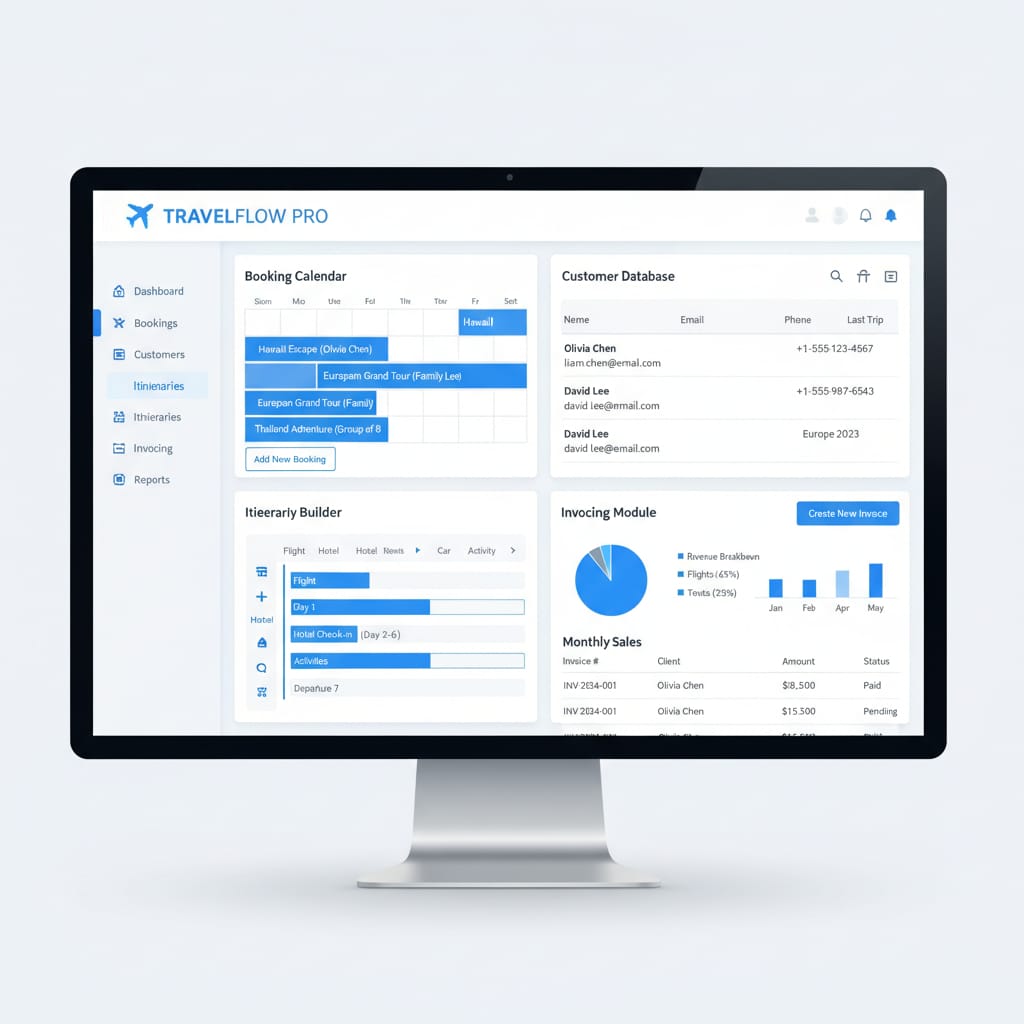
Travel agency management software is a unified digital platform that handles every aspect of running a travel business. Think of it as your virtual back office, booking engine, CRM system, and accounting department rolled into one interface. But here's what makes it different from generic business software: it's built specifically for how travel agencies work.
Generic project management tools don't understand that a "booking" isn't just a task to complete. They don't know that you need real-time availability from multiple suppliers. They can't automatically generate vouchers in the format hotels expect. And they definitely can't calculate your commission on a multi-component itinerary with hotel, tours, and transfers from different vendors.
Core Components
A comprehensive travel agency management system typically includes these interconnected modules:
Customer Relationship Management (CRM)
Store client profiles, track preferences, manage communications, and build relationships that generate repeat bookings and referrals.
Booking Management Engine
Search supplier inventory, check real-time availability, process reservations, and manage confirmations across all product types.
Itinerary Builder
Create professional, day-by-day travel itineraries with customizable templates, maps, images, and detailed activity information.
Invoicing & Financial Management
Generate invoices, track payments, manage supplier costs, calculate margins, and maintain financial records automatically.
Reporting & Analytics
Access real-time dashboards, analyze booking trends, track agent performance, and make data-driven business decisions.
Supplier Integrations
Connect to hotel aggregators, tour operators, transfer providers, and other suppliers through unified API interfaces.
These components work together. When you make a booking, the CRM automatically updates the customer's history. The invoicing module pulls the booking details. The itinerary builder can include the confirmed reservation. Reports reflect the new revenue. Everything stays synchronized without manual data entry.
Why Your Travel Agency Needs Management Software in 2026
Let me be direct: if you're running a travel agency in 2026 without proper management software, you're working harder than you need to and earning less than you could. I don't say this to sell you anything. DMC Quote is free to use. I say it because I've seen the transformation too many times to ignore.
The Manual Workflow Problem
Picture the typical day of an agent without software. A client emails requesting a Singapore trip. You open Booking.com in one tab, Agoda in another, maybe a DMC website in a third. You compare rates across platforms, screenshot the options, paste them into a Word document or email. The client responds with changes. You go back to all those sites, re-check availability (some rooms are now gone), update your comparison, send again.
After confirmation, you manually create an invoice in Excel. You copy booking details from the supplier confirmation email into a Word document to create the voucher. You log the booking in your spreadsheet tracker. You set a calendar reminder to follow up before the trip. And another reminder to request a review after.
For ONE booking. Multiply by 30-50 bookings monthly and you understand why agents burn out, make errors, and miss opportunities.
The Real Cost of Manual Processes
A study of travel agency workflows found that agents without management software spend 47% of their time on administrative tasks: data entry, document creation, file management, and communication tracking. That's nearly half your working hours producing no direct revenue. Software reduces this to 15-20%, freeing 25+ hours weekly for client service and sales.
The Competitive Reality
Your competition isn't just other travel agents. It's Expedia. It's Booking.com. It's Airbnb experiences. Consumers can book travel themselves, instantly, with polished interfaces and instant confirmation. They choose to work with travel agents for expertise, personalization, and service. But if your service is slower, less organized, and more error-prone than self-booking, what exactly are you offering?
Modern clients expect instant quotes, professional documents, and seamless communication. They expect you to remember their preferences from their last trip two years ago. They expect their itinerary to be accessible on their phone while traveling. Meeting these expectations manually is possible but unsustainable.
Scaling Without Breaking
Here's the scenario I see repeatedly: an agent builds a solid client base through excellent service. Word spreads. Referrals increase. Suddenly they're overwhelmed. They can't take on more clients without sacrificing the service quality that built their reputation. Growth stalls, or worse, quality drops and the business contracts.
Software breaks this ceiling. The same systems that handle 20 bookings can handle 200 with minimal additional effort. Automated follow-ups don't require more hours. Template-based documents don't take longer to generate. Centralized information doesn't get harder to find as volume increases.
Growth Math
A solo agent manually processing bookings typically maxes out at 40-60 bookings monthly before quality suffers. The same agent with proper software can handle 150-200 bookings. At an average commission of $150 per booking, that's the difference between $6,000-9,000/month and $22,500-30,000/month in revenue. Same agent, same hours, different tools.
Essential Features of Travel Agency Management Software
Not all travel agency software is created equal. Some platforms excel at booking but lack CRM. Others have great reporting but clunky user interfaces. Here's what to prioritize based on what actually moves the needle for travel businesses:
Must-Have Features (Non-Negotiable)
- Real-time supplier connectivity: Live availability and pricing from hotels, tours, transfers. No more "let me check and get back to you" delays
- Unified booking interface: Search multiple suppliers from one screen. Compare rates without tab-switching
- Customer database with history: Every client interaction, preference, and booking in one place
- Automated document generation: Vouchers, itineraries, and invoices created instantly from booking data
- Cloud-based access: Work from anywhere. No software installation. Mobile-friendly
- Multi-currency support: Handle international pricing and payments without currency spreadsheets
Important Features (High Value)
- Itinerary builder with templates: Create professional, branded documents efficiently
- Payment gateway integration: Accept credit card payments directly
- Automated reminders and follow-ups: Never miss a pre-trip check-in or post-trip review request
- Reporting dashboard: Track revenue, margins, booking volume, and trends
- Role-based permissions: If you have staff, control who sees and does what
- API documentation: If you need custom integrations with your website or other tools
Nice-to-Have Features (Bonus)
- White-label options: Client-facing booking engine under your brand
- Automated pricing rules: Set markup percentages automatically by product type or supplier
- Lead capture forms: Website integration to collect inquiry details directly into CRM
- Accounting software integration: Sync with QuickBooks, Xero, or similar
- Client mobile app: Travelers access their itinerary on their phones
| Feature Category | Without Software | With DMC Quote |
|---|---|---|
| Hotel Search | Check 5-10 sites individually | One search, 50K+ hotels |
| Quote Creation | 30-60 minutes | 5-10 minutes |
| Booking Confirmation | Hours to days | Instant |
| Invoice Generation | Manual creation | Automatic from booking |
| Customer History | Memory + email search | Complete profile view |
| Reporting | Build spreadsheets monthly | Real-time dashboards |
Travel Agency CRM: Client Records, Leads and Follow-ups
Travel CRM software isn't just a contact list. It's the foundation of relationship-based selling, and relationships are what differentiate travel agents from booking websites. A travel agency CRM has to hold the things a generic sales CRM has no field for — passport expiry, seat and meal preferences, who travelled with whom, which supplier the last booking went through.
Customer Profiles That Actually Help
Basic CRM stores names and emails. Travel-specific CRM stores:
- Passport details (names as they appear, expiration dates, nationality)
- Travel preferences (window vs. aisle, room type, dietary requirements)
- Past bookings with full details (easy re-booking similar trips)
- Special occasions (anniversaries, birthdays for personalized touches)
- Communication history (every email, call note, quote sent)
- Referral connections (who referred them, who they've referred)
- Budget preferences (price-sensitive vs. premium focus)
When a repeat client calls, you should see their entire history before you even say hello. "Good morning Mr. Patel, are you calling about another Maldives trip like last February?" That's the kind of service that builds loyalty and referrals.
Lead Management
Not every inquiry becomes a booking. But every inquiry is an opportunity. CRM tracks leads through your sales pipeline: initial inquiry, quote sent, follow-up scheduled, negotiating, booked, or lost. You can see at a glance how many prospects are at each stage, which quotes are awaiting response, and which leads you haven't contacted in too long.
The Follow-Up Factor
Industry research shows that 80% of travel sales require 5+ follow-up contacts after the initial inquiry. But 44% of salespeople give up after just one follow-up. A CRM with automated follow-up reminders ensures no lead falls through the cracks. That's the difference between a 20% conversion rate and a 35%+ conversion rate.
Segmentation and Targeting
As your client base grows, segmentation becomes powerful. Want to email everyone who's traveled to Southeast Asia about your new Vietnam packages? Filter by destination. Looking to promote premium properties to high-value clients? Filter by average booking value. Running a promotion for anniversary trips? Filter by special occasion dates.
Generic marketing blasts get ignored. Targeted, relevant communications get opened. CRM makes targeted communication possible.
Booking Management System
The booking engine is where your software earns its keep. Every minute saved searching for availability, every error prevented in data entry, every instant confirmation instead of waiting for supplier response, translates directly to more bookings and happier clients.
Unified Search Across Suppliers
DMC Quote connects to multiple hotel suppliers, tour operators, and transfer providers through APIs. When you search for hotels in Singapore for July 15-18, you see consolidated results from all connected suppliers in one view. Rates, room types, cancellation policies, all side by side. No more opening 10 browser tabs and manually comparing.
This isn't just convenience. It's competitive advantage. While another agent is still checking the third website, you've already sent a complete quote with options across 50,000+ properties.
Real-Time Availability and Pricing
Nothing damages client trust faster than quoting a rate you can't actually book. With live supplier connections, you see current availability and pricing, not last week's rate sheet. When you confirm a booking, it's confirmed instantly with the supplier. No awkward callbacks saying "sorry, that room sold while we were emailing."
Multi-Component Bookings
Real travel packages include hotels, tours, transfers, maybe activities and dining. Managing these as separate bookings with different suppliers is chaos. Proper booking software lets you build complete packages: 4 nights Marina Bay Sands + Universal Studios tickets + airport transfer + city tour. One package, one invoice, one itinerary, with all components linked.
The Confirmation Number Nightmare
Agencies without booking management often have confirmation numbers scattered across email threads, supplier portals, and sticky notes. When a client calls about their booking, you're searching frantically while they wait. Centralized booking management means every confirmation is in one place, instantly retrievable.
Modification and Cancellation Handling
Travel plans change. Clients add nights, switch hotels, cancel components. Good booking software handles modifications through the same interface as original bookings. You can see cancellation policies before processing, calculate any penalties, and process changes with proper documentation. The audit trail shows exactly what was booked, when it was changed, and by whom.
Itinerary Builder: Creating Professional Travel Documents
Your itinerary is often the first tangible thing clients receive after booking. It shapes their perception of your professionalism and the trip ahead. A sloppy, text-only Word document says something very different than a beautifully formatted, branded document with photos, maps, and clear day-by-day organization.
Day-by-Day Organization
Good itinerary builders let you organize travel chronologically: arrival day, each full day, departure day. Within each day, you add activities, accommodation details, meal arrangements, and notes. The visual timeline makes complex multi-destination trips comprehensible at a glance.
Automatic Booking Integration
When you've booked a hotel through the system, those details should flow into your itinerary automatically. No re-typing confirmation numbers, addresses, or check-in times. When a booking changes, the itinerary updates. This integration prevents discrepancies between what's booked and what's documented.
Customizable Templates
Your itinerary should look like it came from your agency, not generic software. Template customization lets you add your logo, choose fonts and colors, include your contact information, and maintain consistent branding. Some platforms offer multiple templates for different trip types: luxury, adventure, family, corporate.
Digital vs. Print Itineraries
Modern travelers want digital access to their itineraries. But many still appreciate a printed copy, especially for complex trips or less tech-savvy clients. Good itinerary builders export to PDF for printing and offer digital viewing options. Some provide client apps where travelers can access their itinerary on their phones, complete with maps, confirmation numbers, and emergency contacts.
Rich Content Capabilities
An itinerary with just text is informational. An itinerary with photos of the hotel room, maps showing the tour route, and icons indicating meals included is experiential. It builds excitement before the trip starts. Rich content capabilities let you add:
- Property and destination photos
- Google Maps integration for locations
- Icons for quick visual reference (meals, transfers, activities)
- Important reminders and tips
- Emergency contact information
- Links to additional resources
Invoicing and Payment Management
Getting paid should be the easy part. You've done the work of finding options, building the itinerary, processing bookings. Yet many agencies struggle with invoicing: slow to send, difficult to track, awkward payment collection. Modern software makes financial management nearly automatic.
Automatic Invoice Generation
Once a booking is confirmed, generating an invoice should be one click. The system pulls all relevant details: client information, booking components with prices, taxes, any discounts applied, payment terms. Your branded template formats everything professionally. Total time: 30 seconds versus 30 minutes of manual creation.
Multi-Currency Handling
International travel means international currencies. You might pay a Singapore supplier in SGD, a Thai DMC in THB, while invoicing your client in USD or their local currency. Proper software handles currency conversion automatically, tracks costs and revenue in different currencies, and generates reports that make sense regardless of which currencies were involved.
Payment Tracking
Large bookings often involve deposits, partial payments, and final balances. The system should track what's been paid, what's outstanding, and when payments are due. Automatic reminders for upcoming payments prevent awkward conversations and cash flow problems.
Payment Gateway Integration
Waiting for bank transfers adds days to your payment cycle. Integrated payment gateways let clients pay by credit card directly through your invoice. Some platforms, including DMC Quote, offer secure payment processing that deposits directly to your account. Faster payments mean better cash flow and fewer collection headaches.
Supplier Cost Management
Your profit is the difference between what clients pay and what you pay suppliers. Tracking this accurately requires knowing actual costs, not just sell prices. Management software records supplier costs alongside client invoicing, automatically calculating your margin on each booking and overall.
Reporting and Analytics
You can't improve what you don't measure. But manual reporting is so painful that most small agencies don't do it consistently. They fly blind, reacting to problems rather than preventing them, missing opportunities they never saw. Automated reporting changes this completely.
Real-Time Dashboards
Log in and immediately see: bookings this month vs. last month, revenue YTD, outstanding payments, upcoming departures, conversion rates on recent quotes. No waiting for month-end. No building spreadsheets. The information is always current, always accessible.
Key Metrics for Travel Agencies
The metrics that matter for travel businesses include:
- Booking volume: Total bookings, broken down by time period, destination, product type
- Revenue: Gross revenue, net revenue after supplier costs, average booking value
- Margins: Average margin percentage, margin by product type, margin by supplier
- Conversion: Quote-to-booking ratio, time to convert, lost booking reasons
- Customer metrics: New vs. repeat customers, referral rates, customer lifetime value
- Agent performance: If you have staff, track individual bookings, revenue, and conversion rates
Trend Analysis
Comparing this week to last week is useful. Comparing this quarter to the same quarter last year is more useful. Trend analysis reveals seasonality (plan marketing accordingly), growth patterns (are you actually improving?), and early warning signs (bookings dropping before you're in crisis).
Data-Driven Decisions
Good reporting enables strategic decisions. You discover that your margin on Southeast Asian packages is 8% higher than European packages; perhaps focus marketing there. You notice conversion rates dropped after you stopped offering payment plans; maybe reinstate them. You see that clients who book with you three times almost never leave; prioritize third-booking incentives.
Export and Integration
Sometimes you need data in other formats: for your accountant, for tax purposes, for your business partner. Reporting systems should export to common formats (CSV, PDF, Excel) and ideally integrate with accounting software like QuickBooks or Xero for seamless financial management.
Supplier Integrations: The Power of API Connectivity
The value of travel agency software scales with its connections. A standalone system where you manually enter bookings made through supplier websites isn't transformational. A system connected to dozens of suppliers through APIs, enabling real-time search, instant booking, and automatic confirmation, that's transformational.
How API Integration Works
API (Application Programming Interface) is how software systems talk to each other. When DMC Quote searches for hotels in Bangkok, our system sends a request to connected hotel suppliers through their APIs. They respond with current availability and pricing. We display consolidated results. When you book, we send reservation details through the API and receive confirmation. All automated, all instant.
Without API integration, you'd need to log into each supplier's portal separately, search manually, copy rates into your quote, then go back to book, then copy confirmation details into your records. APIs eliminate all that manual work.
Types of Supplier Integrations
- Hotel aggregators: Platforms that themselves connect to thousands of hotels (providing massive inventory through one integration)
- Direct hotel connections: Larger hotel chains with their own booking APIs
- Tour and activity platforms: Operators offering day tours, attractions, experiences
- Transfer providers: Airport transfers, private cars, SIC shuttles
- Travel insurance: Integrated insurance quoting and booking
- Airline GDS: For agencies also handling flights (Amadeus, Sabre, Travelport)
DMC Quote Integration Coverage
DMC Quote aggregates over 50,000 hotels across Asia-Pacific and Middle East through our supplier network. We connect to major hotel aggregators, boutique DMCs, and direct hotel contracts. For tours and transfers, we integrate local operators in key destinations. One search, one interface, thousands of options.
The Single Source of Truth
When all your suppliers connect through one platform, that platform becomes your single source of truth. Every booking is there. Every confirmation is there. Every supplier cost is recorded. This simplifies reconciliation, prevents errors from duplicate data entry, and creates a complete audit trail for your business.
How to Choose Travel Agency Management Software
The software market is crowded. Enterprise solutions, mid-market platforms, niche tools, generic business software with travel plugins. How do you evaluate options for your specific situation?
Consider Your Business Size and Model
A solo home-based agent has different needs than a 50-person agency. A B2B wholesaler has different requirements than a B2C leisure specialist. Before evaluating features, clearly define:
- How many users need access?
- What products do you sell? (flights, packages, hotels only, FIT, groups?)
- Who are your clients? (B2C consumers, B2B agents, corporate accounts?)
- What suppliers do you work with currently?
- What's your technical capacity? (need simplicity or can handle complexity?)
- What's your budget for software? (monthly cost, implementation cost, transaction costs?)
Pricing Models Compared
| Pricing Model | Typical Cost | Best For |
|---|---|---|
| Enterprise License | $10,000-$100,000+ annually | Large agencies with custom needs |
| Monthly Subscription (SaaS) | $100-$500/month | Mid-size agencies with consistent volume |
| Per-User Pricing | $30-$100/user/month | Growing teams scaling gradually |
| Transaction-Based | $0 monthly + per-booking fee | New/small agencies, variable volume |
| B2B Portal (like DMC Quote) | $0 + built-in margins | Agents using platform for supply |
Questions to Ask Vendors
- What suppliers are integrated? Are my key suppliers included?
- What's the implementation timeline and process?
- Is training included? How long until my team is proficient?
- What support is available? Hours? Response times? Channels?
- Can I see the system before committing? (Demo, trial period)
- What happens to my data if I cancel?
- How often is the platform updated? What's the development roadmap?
- Who else in my market segment uses this successfully?
Red Flags in Software Selection
Watch for: long-term contracts with limited exit options, hidden implementation fees beyond quoted prices, vague answers about supplier connectivity, no demonstration of actual bookings through the system, and resistance to providing references from similar agencies.
Implementation Guide: Getting Started Successfully
Software only works if people actually use it. Many implementations fail not because the software is bad but because adoption is poor. Here's how to set yourself up for success:
Phase 1: Preparation (Before Implementation)
Define Your Requirements
Document your current workflows. What are you doing well? What's painful? What absolutely must improve? Prioritize features into must-have, important, and nice-to-have categories.
Clean Your Data
If migrating from another system or spreadsheets, clean your data first. Duplicate customers, incomplete records, and outdated information will only create problems in your new system.
Plan Your Timeline
Don't implement during your busiest season. Allow time for learning before you need full productivity. For complex migrations, consider running old and new systems in parallel briefly.
Phase 2: Setup and Configuration
Account Setup
Create your account, complete verification requirements, and configure basic settings: company information, branding, user accounts and permissions, default currencies, and markup rules.
Data Migration
Import customer records, if applicable. Larger platforms offer import tools; smaller ones may require manual entry. Prioritize active customers and recent booking history.
Customization
Set up templates for itineraries and invoices. Configure automated emails. Adjust default settings to match your workflow preferences.
Phase 3: Adoption and Training
Learn the System
Complete available training resources: videos, documentation, webinars. Process a few test bookings before going live with real clients. Identify questions before you need urgent answers.
Start with New Bookings
Begin using the new system for all new bookings. Don't try to migrate in-progress bookings; let those complete in your old system. The goal is building new habits.
Iterate and Improve
After a few weeks, evaluate what's working and what isn't. Adjust workflows. Ask for additional training on underutilized features. Optimize based on real usage experience.
The 30-Day Challenge
Commit to using your new software for EVERY relevant task for 30 consecutive days. No falling back to old methods because they're familiar. By day 30, new workflows become habit, and you'll wonder how you worked without them. Resist the temptation to "just this once" use the old way; it delays the transition indefinitely.
DMC Quote: Built for Modern Travel Agents
DMC Quote isn't just software; it's a complete B2B travel platform. We combine management software functionality with direct supplier access at wholesale rates. Here's what that means for your business:
What You Get
Wholesale Supplier Access
50,000+ hotels, tours, and transfers at net rates. Access the same inventory major wholesalers have, without their minimum volume requirements.
Zero Monthly Fees
Registration is free. No software licenses, no monthly subscriptions. You only pay when you book, and the cost is built into supplier rates.
Instant Booking Engine
Real-time search, instant confirmation, professional vouchers. Everything connected, nothing manual.
Agent Dashboard
Manage bookings, track wallet balance, view statements, download reports. Your complete business overview in one place.
Who It's For
- New travel agents: Start with professional tools without startup capital
- Established agencies: Access wholesale rates, improve margins
- Tour operators: Source components for packages efficiently
- Corporate travel managers: Handle business travel with transparent pricing
- Freelance agents: Operate independently with enterprise-grade infrastructure
The DMC Quote Difference
Most software charges you monthly whether you book or not. Most supplier portals give you rates but no management tools. DMC Quote combines both: comprehensive booking management with direct wholesale access. One platform, one login, everything you need to run a modern travel business.
The Future of Travel Agency Software
Technology in travel evolves rapidly. The software that's cutting-edge today will be basic tomorrow. Here are trends shaping where management software is heading:
AI and Automation
Artificial intelligence is already entering travel software. Current applications include: automated quote generation based on client preferences, chatbots handling initial inquiries, dynamic pricing optimization, and predictive analytics for booking patterns. Expect AI to handle increasingly complex tasks while agents focus on high-value consultative work.
Mobile-First Design
Agents increasingly work from phones and tablets, not just desktops. Software designed for mobile enables responding to clients immediately, making bookings on the go, and running your business from anywhere. Clunky mobile experiences will become deal-breakers.
Enhanced Personalization
As CRM data accumulates, software will enable hyper-personalized recommendations. "Based on Mr. Chen's past bookings, he'll likely enjoy this boutique hotel" generated automatically rather than through agent memory.
Deeper Integration Ecosystems
Expect more connections between travel software and other tools: accounting, marketing automation, customer communication platforms. The goal is a unified technology stack where data flows seamlessly between specialized tools.