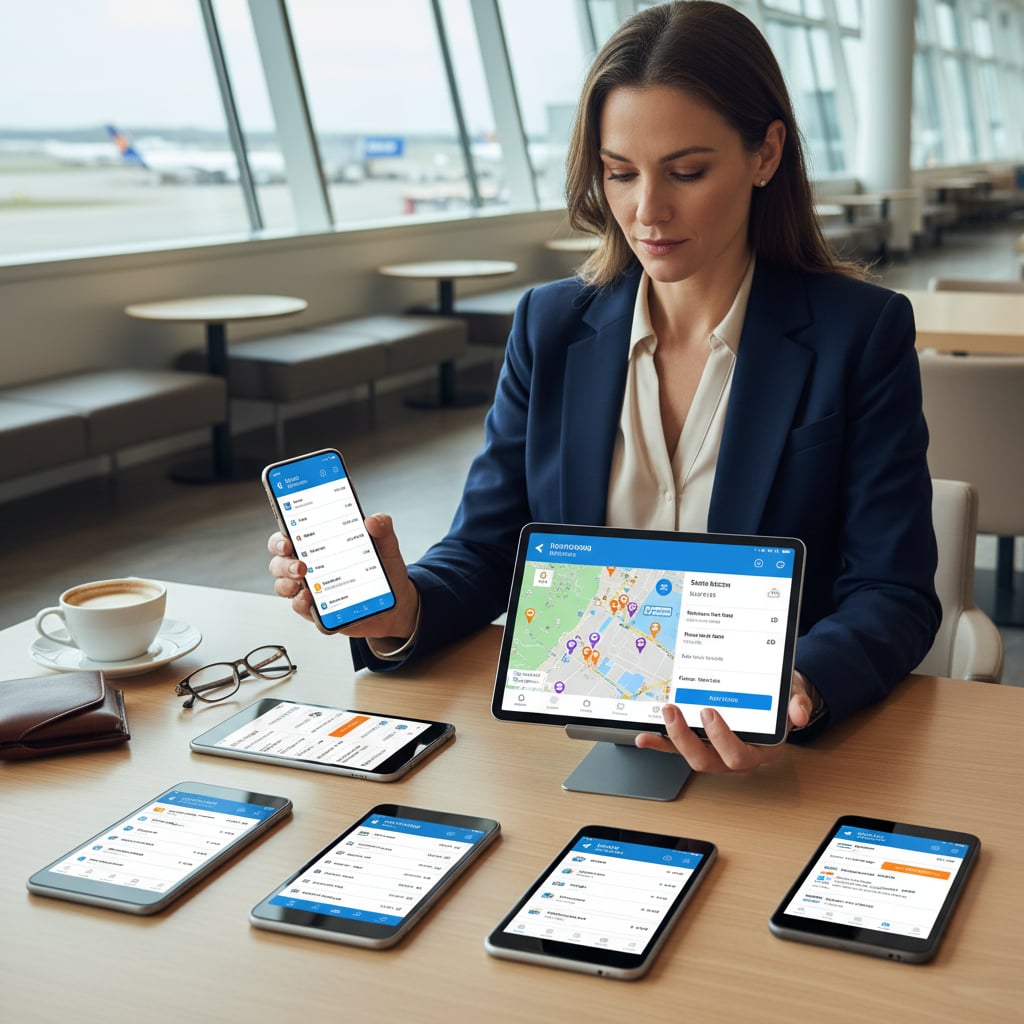
On 27 August 2026, Google started letting people book hotels without leaving Search. In AI Mode, a traveller describes the trip, gets a shortlist with reviews, picks a room and pays with Google Pay, all inside Google. Booking.com, Expedia, Marriott, Hilton, IHG and Trip.com are among the launch partners. For travel agents, it is the clearest sign yet that simple hotel bookings are moving into AI assistants, and a useful moment to look at what that does and doesn't change for your business.
For the bookings AI assistants can't handle, our B2B hotel booking portal gives agents live net rates on 1.5M+ hotels worldwide, with instant confirmation.
This guide explains exactly what Google launched, how Google AI Mode hotel booking works, where it's available, what it leaves out, and what we think agents should do about it this quarter. Facts come from Google's own announcement and the industry analysis published since; where something is our opinion, we say so.
Key Takeaways
- Google AI Mode hotel booking launched on 27 August 2026 in the US, in English, with more regions promised "over the coming weeks".
- Travellers book and pay with Google Pay inside AI Mode. The hotel or booking platform remains the merchant of record and handles customer service.
- Flights are not booked inside Google yet. AI Mode tracks prices and builds itineraries, then sends the traveller to the airline or a booking site.
- The booking standard behind it, according to industry analysis, has no fields for travel agency identification, commissions, negotiated rates or group blocks.
- Single-hotel bookings for self-sufficient travellers are the most exposed. Multi-component trips, groups, visas and payment terms are where agents keep their edge.
What Google Launched in AI Mode
Google announced three travel features together. Only one of them completes a booking inside Google.
| Feature | What it does | Where available at launch | Booked inside Google? |
|---|---|---|---|
| Hotel booking | Find, compare and book a hotel in the AI Mode chat, pay with Google Pay | US, English; more regions "over the coming weeks" | Yes, through integrated partners |
| Flight price tracking | Set fare alerts while chatting; prices from 300+ airlines and travel sites | 180+ countries and territories, excluding the EEA | No, purchase happens on the airline or booking site |
| Points and miles | Shows the points or miles needed for flights and hotels | Global, with some features excluded in the EEA | No, redemption happens on the partner site |
The full announcement is on Google's blog: 3 new ways to plan and book travel in Search.
How Google AI Mode Hotel Booking Works
According to Google, the flow is five steps:
- The traveller describes the trip and what they want in a hotel. AI Mode returns a visual list with guest reviews and comparison points.
- They ask AI Mode to help complete the booking.
- Next to an integrated partner, they select "Continue on Google".
- They choose a room type and review details such as the cancellation policy.
- They pay with Google Pay.
The hotel or the booking platform is the merchant of record, so the reservation, the payment terms and any customer service sit with them, not with Google.
The launch partners
Google named ten hotel booking partners: Booking.com, Choice Hotels International, Expedia, Hilton, Hotels.com, IHG Hotels & Resorts, Marriott International, Priceline, Trip.com and Wyndham Hotels & Resorts. That is the big online travel agencies and the big chains. Independent hotels, regional chains, bed banks and DMC allotments are not on the list.

What Google AI Mode Hotel Booking Leaves Out
This is where it gets interesting for the trade. Industry analysis of the booking standard Google adopted, the Universal Commerce Protocol, found that its lodging specification covers rate lookup, availability and direct booking, but has no data fields for:
- travel agency identification
- agency commissions
- negotiated corporate rates that need agency access
- group room blocks and attrition
- meeting and event terms
As a Hospitality Net brief summarising that analysis put it, "The protocol is not unfinished; it is finished, and it was not designed to include these things."
In plain terms: the AI booking layer is built for one traveller booking one room at a public rate. It is not built for the business most agents actually do.
Other limits worth knowing
- Geography: at launch it is US and English only. Google says more regions are coming, but gave no list or dates.
- Flights: AI Mode does not book them. It tracks prices and hands the traveller over to the airline or a booking site.
- Packages: nothing in the launch combines hotels with transfers, tours, visas or flights into one booking.
- Support: when something goes wrong, the traveller deals with the OTA or hotel that took the booking.
What Google AI Mode Hotel Booking Means for Travel Agents
Here is our view, for what it's worth. Nothing about this launch changes your business this month, especially if your clients are not in the US. But it does tell you which parts of your work an AI assistant will compete with first.
Most exposed: the single hotel, booked for someone who could do it themselves
If a share of your revenue is booking one well-known chain hotel for a client who is comfortable online, that is exactly what AI Mode is designed to do, at public rates and with the convenience of Google Pay. Expect those clients to try it once it reaches your market.
Least exposed: everything with more than one moving part
- Multi-city and multi-component trips: hotels in three cities, airport transfers, attraction tickets and tours, priced as one package.
- Groups and MICE: room blocks, release dates, attrition and meeting terms, none of which the protocol supports.
- Visa-heavy markets: clients from India, Pakistan, Bangladesh, the Philippines and elsewhere need visa guidance that changes often. Thailand cut its visa exemption from 60 to 30 days on 15 September 2026; assistants trained on older data still give the old answer. Our Southeast Asia visa guide has the current rules.
- Payment terms and credit: agency wallets, credit lines and staged payments for big bookings.
- After-sales: overbookings, flight changes and on-trip problems, where a person who knows the client and the supplier still matters.
Clients will arrive with AI-built plans
You already get OTA screenshots. Next come AI-generated itineraries. Treat them the same way: do not argue with them, rebuild them from net rates, fix what is wrong (seasonality, transfer times, visa rules), and show the client what the AI missed. Our guide to travel agent hotel rates vs public rates covers how to answer a client who has found a lower price online.

Same Trip, Two Ways: AI Mode vs an Agent with Net Rates
To make this concrete, take a typical enquiry: a family of four from Mumbai, five nights split between Singapore and Bali in December, with airport transfers, Universal Studios and a Bali day tour. Here is what each route can handle today, based on what Google has launched.
| Trip component | Google AI Mode (as launched, August 2026) | Agent using a B2B portal |
|---|---|---|
| Hotels in two cities | Yes, one booking at a time, US users only at launch, public rates from partner OTAs and chains | Both hotels in one quote, at net rates, with the agent's markup |
| Flights | Price tracking only; ticket bought elsewhere | Coordinated with hotel dates and transfer times |
| Airport transfers | Not included | Private or seat-in-coach transfers booked with the hotels |
| Attraction tickets and tours | Not included | Tickets and tours priced into the same package |
| Visa guidance | General answers, which may be out of date | Current rules for the client's passport, checked before quoting |
| Payment | Google Pay, per booking | One invoice; agency wallet or credit terms |
| Changes and problems on the trip | Handled by each OTA or hotel separately | One point of contact who knows the whole booking |
None of this means AI Mode is weak. It is very good at the job it was built for. The point is that the job is narrower than the job your clients pay you to do.
How Travel Advisors Are Using AI Themselves
The agents who will do best are not the ones ignoring AI. SmartFlyer's 2027 Travel Trends Report says six in ten of its advisors have built AI into their workflow, and that the most strategic advisors use it to streamline back-office tasks rather than for recommendations.
Practical uses we see agents adopting:
- First drafts of day-by-day itineraries, which the agent then prices and corrects.
- Client emails and WhatsApp replies in the client's language.
- Summarising long supplier terms, such as cancellation and release clauses, before quoting.
- Turning a messy enquiry into a structured brief: dates, pax, budget, must-haves.
One rule applies to all of it: check every fact the AI gives you against a current source before it reaches a client. Visa rules, taxes and opening dates change, and AI answers lag behind. Japan, for example, raised its departure tax to ¥3,000 in July 2026 and changes its tax-free shopping rules on 1 November 2026, as covered in our Japan 2026 changes guide.
If you would rather use AI on top of live inventory than on top of guesswork, DMC Quote's AI package builder turns a chat description into a priced, day-by-day quote using live South East Asia rates. Our earlier post on AI travel package builders compares manual and AI quoting time.
What to Watch Next
Google described the launch as a start, not a finished product. Four signals will tell you how fast this reaches your clients:
- New regions. Hotel booking began in the US in English. When Google names the next countries, check whether your source markets are on the list. The EEA is already excluded from flight price tracking and some points features, so Europe may move more slowly.
- Flights. Today AI Mode hands flight purchases to airlines and booking sites. If Google starts completing flight bookings inside Search, the simple flight-plus-hotel trip becomes self-service too.
- More partners. Google said Accor, Flying Blue, Hyatt, LATAM Airlines and Lufthansa Group would join the points and miles feature in the following weeks. Watch whether independent hotels, regional chains and wholesalers are added to hotel booking.
- Trade fields in the protocol. If the booking standard adds agency identification, commissions or group blocks, agencies could plug in directly. Until then, the AI booking layer routes around them.
If Your Clients Are in the US
US-based agents feel this first, because AI Mode hotel booking is live for US users now. Expect your most self-sufficient clients to try it for weekend breaks and simple city stays. The work worth protecting is the work AI Mode cannot do: international trips with several components, family and group travel, honeymoons with multiple resorts, and trips to destinations where entry rules change often. For Asia and the Middle East, that last point matters a lot. Our B2B travel portal for US agents covers net rates in those regions.
Where AI Assistants Get Their Facts
AI assistants answer travel questions by reading the web. That cuts both ways for agencies. If your website, Google Business Profile and social pages carry current, specific information about the trips you sell, the destinations you know and the rules you check, assistants have something accurate to repeat. If they carry last year's visa rules or prices, those can be repeated to clients long after they stop being true.
Google's own guidance on AI features in Search is that original, first-hand content is what gets surfaced, and that special files or formatting written for AI are not needed. For an agency, first-hand content means what you actually know: the hotel you inspected, the transfer time you measured, the visa rule you checked last week. That is hard for an assistant to invent, and it is exactly what your clients value.
Questions Clients Will Ask You, and Good Answers
As AI booking reaches more markets, some clients will test you with it. These answers work because they are true.
"Why should I not just book the hotel on Google?"
For a single hotel, you might be fine doing exactly that. Where we add value is when the trip has more than one part: we price the hotels, transfers, tickets and tours together at trade rates, we check the visa rules for your passport, and if something goes wrong at midnight, you call one person instead of three companies.
"The AI found it cheaper."
Then let us compare like with like. We will check the room type, the cancellation terms, whether breakfast and taxes are included, and whether the rate is refundable. If the AI price is genuinely better for what you want, we will tell you. Usually the difference is in the conditions, not the price.
"The AI wrote me an itinerary. Can you just book it?"
Yes, and we will check it first. AI itineraries often miss travel times between cities, opening days, seasonal closures and entry rules. We will keep what works, fix what does not, and price it with live availability.
"Is my booking safe if I go through an agent?"
Your booking is confirmed with the hotel or supplier in the same way, with a voucher in your name. The difference is that we stay responsible for the whole trip, and we can rebook or reroute you if plans change.
B2B Distribution Is Moving Too
AI Mode is the consumer side of a wider shift. On the trade side, suppliers are also changing how they reach agents. Expedia Group's B2B division presented two activity projects on 1 October 2026: a Rapid Activities API in beta for partners that sell through their own systems, and a pilot that lets selected UK agencies book Tiqets activities inside the Expedia TAAP agency platform, according to Tragento. Both are limited to selected users for now.
The direction is clear even if the timing is not: hotel-only distribution is becoming a commodity, and the value is moving to packaging. Agents who can attach transfers, tours and attraction tickets to every hotel booking, at trade rates, are building the kind of business that one-room AI booking does not touch. That is why DMC Quote puts hotels, airport transfers, attraction tickets and tours on one platform for agents.
A Checklist for This Quarter
- Know your exposure. Roughly what share of your bookings is a single hotel for a client who could book it alone? That is the part to protect with service, not price.
- Sell the package, not the room. Quote hotels with transfers, tours and attraction tickets, so the comparison isn't one room against one room.
- Use net rates. AI Mode shows public rates. Your margin comes from B2B net rates that consumers cannot see.
- Own the complicated cases. Groups, Umrah, MICE, multi-country trips and visa-heavy markets are where AI booking does not reach.
- Put AI to work in your back office. Drafts, translations and summaries, always checked by a person.
- Keep your own facts current. If your website or WhatsApp catalogue carries old visa rules or prices, AI assistants may repeat them to your future clients.
Short version: AI Mode is coming for the easy bookings first.
If you want net rates on hotels, transfers, tours and attraction tickets in one place, registration is free for travel agents. Create an account, submit your agency details for approval, and start quoting. Register free as a B2B agent.
Frequently Asked Questions
What is Google AI Mode hotel booking?
It is a feature Google launched on 27 August 2026 that lets travellers find, compare and book a hotel inside AI Mode in Google Search, paying with Google Pay. The hotel or booking platform remains the merchant of record and handles customer service.
Where is Google AI Mode hotel booking available?
At launch, in the United States, in English. Google says more regions will follow "over the coming weeks" but has not published a list or dates. Flight price tracking in AI Mode is available in more than 180 countries and territories, excluding the EEA.
Which companies are Google's AI Mode hotel booking partners?
Google named Booking.com, Choice Hotels International, Expedia, Hilton, Hotels.com, IHG Hotels & Resorts, Marriott International, Priceline, Trip.com and Wyndham Hotels & Resorts as launch partners for hotel booking.
Does Google AI Mode show B2B or net rates?
No. It shows the rates offered by its booking partners, which are public, consumer-facing rates. The net rates travel agents get through B2B portals, bed banks and DMCs are not part of it, and the booking standard it uses has no fields for agency identification or commission.
Is Google AI Mode hotel booking available in India or the Middle East?
Not at launch. Hotel booking started in the United States, in English, and Google has not yet named the next regions. Flight price tracking in AI Mode is already available in more than 180 countries and territories outside the EEA.
Can you book flights in Google AI Mode?
Not yet. AI Mode can track flight prices and help build an itinerary, but the ticket is bought on the airline's site or another booking platform. Hotel booking is the only feature in the August 2026 launch that completes a purchase inside Google.
Will AI booking replace travel agents?
It will take some simple bookings, mainly single hotels for travellers who are comfortable booking online. The booking standard behind it has no fields for agency identification, commissions, group blocks or event terms, so multi-component trips, groups and visa-heavy travel remain agent work.
How are travel agents using AI?
Mostly in the back office. SmartFlyer reports that six in ten of its advisors use AI in their workflow, with the most strategic using it to streamline back-office tasks. Typical uses include drafting itineraries and emails, translating, and summarising supplier terms. Every fact an AI produces still needs checking before it reaches a client.